01 How to Play
TZER0 Core is a tabletop role-playing engine. It’s a toolkit you and your friends can use to create a diverse cast of characters as well as a world for them to explore and existential threats for them to face.
The Game World
TZER0 makes few assumptions about genre or setting so you and your friends are free to dream up whatever world you want. With rules that enhance bare-bones storytelling, TZER0 offers a simple framework as well as reference examples for structuring play and resolving in‑game actions —— regardless of the world you aspire to build.
The Guide
You’re an experienced roleplayer who assumes primary responsibility for understanding and interpreting TZER0’s rules as well as onboarding new Players. You prepare and run game sessions, devising the setting and portraying the world’s countless inhabitants. You offer details about specific situations and elaborate on events as they unfold. If your group can’t agree how to resolve an issue, you have final say to keep the story moving forward.
The Players
You’re the heroes of the story. You see the game world through your characters’ eyes. Think like them. Act like them. Make decisions as if you actually are them.
The Core Mechanic
Rule TZER0
Only apply rules when they make sense and enhance the story, never otherwise.
Role playing is about having fun with your friends using your imaginations. Things that make sense in play don’t need to mirror real life. In fact, most styles of play favor cinematic impact over rigid realism. But the action your group imagines should come before the rules as written, or you risk weakening your sense of immersion.
Roll d0
To find out what happens whenever “what happens” is both in doubt and dramatically significant, TZER0 uses two six-sided dice to roll Tests. One die is positive (+1..+6), the other is negative (-6..-1).
We call this combination “dTZER0” or “d0” for short. Added together, d0 yields a number between -5 and +5, which is usually adjusted by your character’s Competence and may be modified by other factors such as Trauma. When you compare this total to a Target representing the difficulty of your task (notated as [> Target] —— e.g., [> ±0] or [> +2]), you arrive at a Net Effect for the roll.
Net Effect = d0 + Competence + Modifiers - Target
Net Effect indicates your magnitude of success or failure. Use it to grade Test outcomes. You enjoy some degree of success when your Net Effect is ±0 or greater; otherwise, your effort falls short.
The Drill
Play typically proceeds as follows:
- Set the scene. Your Guide describes where you are and explains who or what else of interest is nearby —— perhaps informed by input from the group. Once the scene has been set, it’s customary for your Guide to ask: “What do you do?”
- State your goal. Imagine how your character would think about the situation and how they would conduct themselves under the circumstances. In other words, what’s their MO? Then announce what you hope to accomplish as well as how you intend to accomplish it.
- Decide how things turn out. If your objective entails a meaningful challenge as well as consequential risks and rewards, your Guide will ask you to roll a Test to find out what happens; otherwise, you’ll usually achieve your goal as intended.
- Depict the outcome. Whether you succeed or not, your Guide will explain how the scene evolves, occasionally relying on you to portray your character’s effort and its effect. Then continue at (1) with the next Player or with the Guide, who portrays the environment and acts on behalf of any non-player characters.
The Details
The chapters that follow explore in depth the elements that define who your character is as well as the mechanics that establish what happens when they interact with the story world.
- Characters: Bring your character to life with fiction-forward mechanics.
- Constraints: Facts delineate the boundaries of what is and isn’t possible in play.
- Competence: Your character’s Constraints suggest their aptitude for completing individual tasks effectively and efficiently.
- Exceptions: In specific situations, the rules of the game can be tweaked to reflect your character’s unique strengths and weaknesses.
- Edge: Create immediate advantages, influence the story, and make character improvements over time.
- Tests: In the simplest terms, roll d0 to find out what happens whenever “what happens” is both in doubt and dramatically significant.
- Threats: Factions come to blows. Story worlds bristle with environmental hazards and other dicey challenges.
- Supernature: Certain faculties and phenomena are strange beyond the understanding of natural philosophy or physical science.
- Materiel: The things you carry —— tools of the trade, armor, weapons, and provisions, among other things —— are more than mere props.
02 Characters
In practice, role playing only works with characters —— whether it’s player characters or Guide-run non-player characters. Without them, there aren’t any roles to play or much of a story to tell.
Before You Begin
Whenever you create a character, take a look at the following strategies. You can use these methods to work through writer’s block and keep the process flowing.
Leave blanks. Don’t feel obligated to finalize your character before playing. Blanks are better than weak ideas, and sometimes it’s easier to wait for inspiration to strike than it is to seek it out. The rules leave space for you to explore your character in play so you can flesh out details as you go.
Beg, borrow, and steal. Numerous role-playing games and other works are based entirely on existing franchises. You too should feel free to adapt elements from your favorite characters in novels, comic books, movies, TV shows, or video games, among other media. Whether you reskin a single character or mash up multiple characters, you can always find inspiration by studying existing works of art.
Collaborate. Give every Player in your group time to flesh out their own characters. When everyone is ready, exchange character sheets and review the character you receive. Then write some suggestions on a separate sheet of paper. For example:
- Add a minor descriptive detail such as a catchphrase or habitual behavior.
- Elaborate on a Constraint’s description.
- Illustrate how a Constraint might help or hinder the character.
- Invent a description for a Constraint that doesn’t have one.
- Write a new Constraint or Exception.
- Imagine how the character you’re reviewing is connected to your own character.
Continue exchanging character sheets, along with their corresponding notes, until every Player has reviewed every other Player’s character at least once. Then give everyone time to incorporate these suggestions.
Stay flexible. When it comes time to actually play the game, no matter how carefully you may have crafted your character, you might feel like one or two elements aren’t working as expected. If an element isn’t panning out in practice, ask your Guide or your group for help revising or replacing it.
Creating Characters
Every character you create will be shaped by several elements.
- Guide’s Input: Information about the game your Guide plans to run
- Description: Details that might appear on a passport or wanted poster
- Constraints: Free-form descriptors that reveal key facts about your character
- Exceptions: Unique features that influence your performance in special cases
- Competence: The efficacy of in-game actions depends on your Constraints
- Edge: A pool of points you can use to influence the game
- Stress and Trauma: Thresholds for non-lethal and lethal damage
- Materiel: Tools of the trade, armor, weapons, provisions, and the like
Although each of these elements is summarized below, most are explained fully in subsequent chapters. Reading ahead will help you understand how they function and may shed light on certain aspects of the character creation process. If you want to play a spell slinger or other character who operates outside the conventional laws of reality, be sure to review 09 Supernature, especially Who Can Manifest?
Guide’s Input
Your Guide will introduce the game’s Concept, including details on house rules, tone, safety tools, and story hooks. They may also invite you and your fellow Players to collaborate on these elements.
Description
The sort of identifying features that might appear on a passport, driver’s license, or wanted poster —— name, aliases, age, sex, gender, height, weight, hair, eyes, and complexion —— as well as information about your mannerisms and attire help establish the picture of a nuanced and realistic character. For example:
- Cate Hasegawa: 5'3" twenty-something, deceptively petite, brown-hazel eyes, lightly freckled nose and cheeks, black A-line long bob (short in the back, gradually longer toward shoulder-length front). Wallet chain, dark denim skinny jeans, faded black high-top tabi sneakers, gray zip hoodie with pink draw strings under band-collared black motorcycle jacket.
Constraints
Constraints are facts the story must honor. Each one is a concise description revealing something consequential about your background, personality, beliefs, relationships, problems, and goals, among other things. Begin play with at least your Concept. In addition, you may define 4 other Constraints: 1 Hallmark, 1 Connection, and 1 Risk, plus another Hallmark or Connection.
Concept
Your Concept is the only Constraint you must define before you play a new character. It should hook into the story world they will inhabit and describe your character with just enough detail to be understood. For example:
- Second-story riot grrrl forced to work for the Man. Cate specializes in breaking and entering multistory buildings. She crimed for a few years before getting caught, serving time, and —— in exchange for a suspended sentence —— being recruited for off-book infiltrations and investigations.
A worthwhile Concept answers the following questions, among others:
- What is your nature? Do you have a calling or a sense of purpose?
- What is your occupation, trade, or walk of life?
- What sets you apart from everyone else?
Hallmarks
A Hallmark is one of your character’s distinguishing features. It should add detail to your Concept, explain how you interact with the story world, describe something exceptional about you, and have the potential to propel the story forward or shift it in new directions. For example:
- Wired. Transhuman enhancements are real —— if you know where to look, are willing to pay the price, and don’t mind being an “early adopter.”
- I don’t trust anyone, but you can trust me. When Cate wants to, she can turn on the charm. But don’t expect to charm her.
If you need inspiration, try answering the following questions:
- What do you bring to the table? What about you is cool?
- What major experiences have shaped who you are today?
- What’s your MO? How do you think about and deal with the world around you?
- What set you on your current path?
- What are your aspirations, goals, or other desires?
Connections
A Connection links your character to someone or something else in the story world. Connections include people, places, possessions, institutions, associations, and movements, among other things. For example:
- Brother’s a maladapted prodigy. Henry’s a skilled hacker with social anxiety and collateral drug-seeking behavior. Cate loves him, but struggles to understand him.
If you need inspiration, try answering the following questions:
- How did you get here? Where did you come from?
- Who are your family, friends, and enemies? Who shaped your worldview?
- How do you know the other characters?
- What possession do you value above all others? Why?
Risks
A Risk is a facet of your character that’s bound to complicate life. While all Risks expose you to potentially unwelcome developments, it’s this very dynamic that generates dramatic tension and propels the story in surprising directions. For example:
- Why is this locked? Maybe it’s securing something valuable. Anyway, who isn’t tempted by a wee challenge and the prospect of a profitable side quest?
If you need inspiration, try answering the following questions:
- What about you might draw unwanted attention from others?
- How might your nature bring misfortune upon yourself or others?
- What do you fear? What secret do you keep and hope is never revealed?
- What would inspire you to sacrifice yourself, compel you to violate your principles, or force you to betray an ally?
Writing Effective Constraints
Because Constraints drive in-game decisions, events, and mechanics, an ideal character Constraint is specific, consequential, and multifaceted. It’s quickly called to mind, easy to interpret, and realizes as many of the following goals as feasible. It should…
- Signal what you as a Player want to see in the story. Constraints can only enhance a story if you have a chance to use them. Effective Constraints make it easy for your Guide to tailor challenges to your character and to ensure the game they run meets your expectations.
- Illustrate what makes your character unique or intriguing. Constraints communicate a lot about who your character is. Use evocative, pithy taglines to shine a spotlight on the things that excite you about your character.
- Contain multitudes. An effective Constraint is internally consistent even as it embraces various contradictory aspects with the potential to bring about both positive and negative outcomes.
- Inspire, imply, and inform. In addition to serving as a role-playing prompt, a great Constraint can establish narrative truths, prescribe mechanical effects, and furnish opportunities to expend and acquire Edge.
- Prompt storylines that otherwise might not be considered. The very best Constraints —— in addition to whatever else they may do —— can inspire side quests, longer scenario hooks, and even whole narrative arcs.
- Generate secondary Constraints. Some character Constraints can’t be true unless other interconnected Constraints exist. If you’re a “Member in good standing, League of Illusionists,” such a League must exist.
Exceptions
Exceptions are special cases that modify how your character interacts with the game’s mechanics. Under the right circumstances, they typically give you an advantage. Like a Constraint, every Exception takes the form of a concise piece of descriptive text, which you usually author yourself while taking into account your Guide’s input.
Your character begins play with up to three Exceptions. For example:
- No limits, only obstacles. When Cate finds herself in a situation she can approach like an obstacle course, she takes +2 to move through the environment.
- It’s not the fall, it’s the sudden stop. When Cate falls from a height, or if someone tries to forcefully take her to the ground in hand-to-hand combat, she takes +2 to escape harm.
- Nimoy’s last defense. Using Fast (2) Ready, Cate can attack with either of her hands. They act like stun guns, discharging a disabling electrostatic pulse that inflicts 2×Stress damage and causes subjects to take an Incapacitated Constraint for [Net Success] Rounds. In order to power this attack, Cate takes 1×Stress.
Competence
Your character’s ability to effectively and efficiently achieve an objective stems from their Constraints. Efforts related to their Concept or Hallmarks stand the best chance of success. Conversely, the further an activity diverges from their Constraints, the less qualified they will be to undertake it. Begin play with: +2 Core, +1 Strong, ±0 Basic, -1 Weak, -2 Marginal, and -3 None.
Move and Ready
During a tactical encounter you have limited time to act. Your character’s Move score specifies how many meters you can travel in a single Round on your Turn. Traveling further than that (up to 6× Move meters), attacking, or taking other actions draws down your Ready score until it reaches 0 and you can take no further actions until your next Turn. Begin play with 4 Move and 6 Ready.
Edge
Edge is the currency that fuels your character’s luck, singular talents, and cumulative experience. You can expend Edge to gain an immediate advantage at any time during play, or collect it to unlock character improvements. You begin play with 3 Edge.
Stress and Trauma
Whenever your character is injured, they receive Stress or Trauma. Stress is debilitating but survivable psychic or physical strain resulting from non-lethal attacks or adverse environmental conditions. Trauma is potentially lethal damage resulting from physical injury or the excessive demands of extremely adverse conditions. As Stress and Trauma approach your Maximal thresholds, actions become more challenging.
Begin play with Stress and Trauma thresholds equal to: 0 Minor, 5 Moderate, 10 Serious, 15 Severe, 20 Critical, and 25 Maximal.
Materiel
Materiel are the things you own, or at least carry with you. Although your belongings don’t define your character, they can reveal facets of your identity, symbolize your beliefs and spiritual practices, signal your economic and social status, and secure your comfort and survival.
Begin play with everyday items (such as clothing and possessions with personal significance) plus a loadout that makes sense for your character based on their Concept. Pick from the items detailed in 10 Materiel, or use them as the starting points for your own inventions. Note that if your loadout requires more than 8 Gear Slots, you will be Encumbered unless you write an Exception to increase your Gear Slot allowance.
Resources
A composite of your character’s “buying power,” including income and savings as well as credit-worthiness, Resources approximate your character’s financial condition without enumerating every last copper, dime, or credit. Begin play with ₹3 Resources.
03 Constraints
Constraints are facts the story must honor. Each one takes the form of a concise tagline that reveals at least one significant detail about the setting, the story, the current scene, your character, or any event, place, or thing imaginable —— if it’s narratively useful, make it a Constraint.
How to Use Constraints
Constraints define space for action and creativity. They…
- Inspire. Constraints tell you what’s memorable and consequential about whatever they’re attached to. Use them to draw attention to unique details, stimulate creativity, and prompt role playing.
- Imply. As facts the story must honor, Constraints establish narrative truths that just make sense. In that capacity, they can predetermine rulings; for instance, a police detective should have privileged access to their own precinct.
- Inform. Constraints present opportunities to expend Edge in exchange for narrative and mechanical advantages, and to acquire Edge as compensation for facing similar disadvantages (see 06 Edge). Furthermore, they often call attention to actions that warrant Tests —— attempting to climb a Rotting rope ladder merits a Test that clambering up a typical sturdy ladder does not.
Kinds of Constraints
Strictly speaking, there aren’t different “kinds” of Constraints —— they’re all just facts, albeit important ones. But we can talk about how Constraints commonly come into play.
Character Constraints
A character Constraint describes any seminal, more or less permanent feature associated with a character. These Constraints outline who your character is, how they conduct themselves, which tasks they will and will not perform well, which people or things are important to them, and what might come back to haunt them, among other things.
That said, some Character Constraints reflect short-lived, immediate developments and opportunities. For example: Disarmed, Flanked, or Flat on your back. When circumstances are especially fleeting, they’re expressed as Next Modifiers.
Next Modifiers
Typically, you take a Next Modifier as a +2 bonus when you roll exceptionally well, or as a -2 penalty when you roll poorly. When you roll ±0, you might come away with a bonus, a penalty, or neither, depending on the circumstances (see 07 Tests).
Next Modifiers may or may not be accompanied by a tagline to articulate the rationale for the modifier or to suggest applicable actions. For example: Disrupted grip: -2 Next attack, -2 Next attack, or simply -2 Next.
Although they represent facts, Next Modifiers cease to exist as soon as they’re exercised. With that in mind, as long as they remain relevant and you can narratively justify doing so, you can pass Next Modifiers to other characters.
Narrative Constraints
Narrative Constraints establish noteworthy facts about the story (e.g., a Concept such as A new dark age takes hold), the setting (e.g., a Hallmark such as Earth, 2267), or the current scene (e.g., a Hallmark such as Dense fog). Whether planned or arising spontaneously in play, they add features to the environment that anyone can reference when they want to expend Edge. Although some narrative Constraints are longer-lived than others, none is set in stone —— each one lasts for only as long as it continues to make sense.
Free Edge
When you roll a Test that reinforces an existing Constraint (see below), exposes a previously hidden one (e.g., discovering an adversary’s weakness, such as Flattery will get you everywhere), or alters the scene sufficiently to warrant a new one (e.g., shooting windows so the floor is Covered in shards of glass), you may acquire Free Edge for the Constraint (and only that Constraint). However, depending on the circumstances, your intent, and how you roll, your opposition may end up controlling this Free Edge instead (see 07 Tests, Effects × Side Effects).
Assuming you control it, you can later expend some or all of this Free Edge —— in addition to your own Edge, if you wish —— on another Test, stacking all benefits (see 06 Edge). Furthermore, you can pass any Free Edge you control to any other character who can reasonably benefit from it.
The Constraint Life Cycle
Inception
Most character Constraints —— and any Constraints your Guide devises explicitly for a given scene, session, scenario, or setting —— are formulated outside of play. But Constraints can emerge organically during play as well. They can be…
- Suggested. Information —— whether shared by your Guide, written in this book, or gleaned from a credible reference —— is fodder for gameplay. If you think a Constraint makes sense and you don’t expect Free Edge in return, you can simply bring it up. For example: if your Guide describes the scene as being poorly lit by kerosene lanterns, you should be able to expend your own Edge on the lanterns’ Flickering shadows to bolster a stealth Test even if no one explicitly mentioned it as a Constraint previously.
- Set up. When you take an action with the goal of establishing or exposing a Constraint, you may acquire Free Edge as noted previously. You might, for instance, smash one of those lanterns to the ground, igniting a Wall of flames to shield your escape.
- Triggered. It’s equally possible that your actions might give rise to unintended Constraints —— especially if the result of a Test imposes a setback or complication. As you’re grappling with an opponent, for example, you might knock a lantern into a wall, touching off Flaming drapes.
Adaptation
In addition to expending Edge on an active Constraint, you can roll a Test to…
- Reinforce it. Perhaps you want to add fuel to the fire, making escape through the window behind the Wall of flames that much harder to deal with. If you’re successful, you’ll add Free Edge to the Constraint; otherwise, your opponents may end up with it.
- Revise it. If you don’t want the room to burn out of control with you in it, you can try to douse the flames with a fire extinguisher. If you’re successful, you’ll get Free Edge on a new Fire retardant and smoke in the air Constraint; otherwise, you might not put the fire out or, if you do, you might hand Free Edge on that Constraint to your opponents.
Eviction
The moment any Constraint stops making sense, it ceases to exist.
04 Competence
Your character’s Competence —— their knack for achieving an objective effectively and efficiently —— stems from their Constraints. Efforts related to their Concept stand the best chance of success, but any Constraint can help: the more, the better. Conversely, efforts unrelated to their strengths or at odds with other Constraints will prove trickier.
How Competence Works
A new character typically begins play with Competence scores ranging from +2 (Core) to -3 (None). Every Test you roll is modified by a number from this range according to the following guidelines.
Competence Traits and skill sets essential to achieving your goal are…
| Competence | Traits and skill sets essential to achieving your goal are… |
|---|---|
| Core | Integral to one or more Constraints |
| Strong | Closely related to your Constraints |
| Basic | Plausibly related to your Constraints or common among the general population |
| Weak | Superficially related to your Constraints |
| Marginal | Minimally related to your Constraints |
| None | Unrelated to any Constraint |
When your Guide calls for a Test, they must also determine a suitable Competence score (such as Core, Basic, or Marginal). Typically, they will ask you to name a score, but they might designate one using their own assessment of your character, your stated goal, and your approach given the situation at hand. If there is any doubt, you can advocate for your preferred Competence score by role playing or explaining your position.
Assessing Competence
As you can see, picking a suitable Competence score for a Test is more art than science. Nevertheless, a few high-level criteria can help you assess your character’s Competence for any task.
These criteria take the form of five yes-or-no questions. Answer yes to all five, and you should roll your Test with your character’s Core Competence. Answer yes to four: Strong; three: Basic; two: Weak; one: Marginal; or zero: None.
- Do you have a trait to achieve your goal?
Traits represent your character’s inherent mental, emotional, and physical fitness such as intellect, intuition, and coordination. In the nature versus nurture debate, these are your natural qualities, faculties, and aptitudes, which may be developed but are strongly influenced by biology and genetic inheritance.
Traits take the form of adjectives that describe your character. Examples include: academic (studious, analytical); pragmatic (savvy, rational); commanding (confident, assertive); persuasive (artful, discreet); empathic (sensitive, insightful); vigilant (alert, focused); dexterous (hand-eye coordinated, precise); kinetic (whole-body coordinated, acrobatic); lean (athletic, maximal power-to-weight ratio); massive (formidable, maximal strength); resilient (stress-resistant, self-reliant); and tough (rugged, healthy); among many others.
Answer yes if a Constraint indicates your character’s innate faculties will help achieve your goal.
- Do you have a skill set to achieve your goal?
From acrobatics to zoopharmacognosy, skill sets represent your character’s earned expertise. In the nature versus nurture debate, these are your trained arts, sciences, and other proficiencies, which must be studied and practiced.
When considering this question, think about the specific skill or skills required to achieve your goal. In combat, for example, you can distinguish between armed and unarmed fighting. In unarmed combat, you can distinguish between grappling and striking. In armed combat, you can distinguish between hand-to-hand and ranged weapons. In ranged combat, you can distinguish between firing a weapon and throwing one. And so on.
Answer yes if a Constraint indicates your character has the education, training, or practical knowledge to achieve your goal.
- Have you faced this challenge or a related challenge before?
Although some Constraints may imply familiarity with this or a related challenge, your character will likely gain experience in play that hasn’t already been captured.
Answer yes if a Constraint implies your character has experience related to this challenge or if your character previously faced such a challenge in actual play and gained substantial practical experience as a result.
- Is your approach appropriate for this challenge?
As the saying goes, “If all you have is a hammer, everything looks like a nail.” Sure, you may have faced this challenge or one like it before, and you might be able to use your character’s traits and skill sets to achieve your goal. But are the available approaches, especially the one you picked, optimal?
Answer yes if you’re attempting to achieve your goal in a way that is sensible, clever, and appropriate to the circumstances.
- Do both your goal and approach satisfy all relevant Constraints?
Consider the following example:
You’re attempting to smuggle a dangerous artifact out of its native country, so when customs agents confront your party, you can’t let them know the true nature of your cargo. Now, as an Accomplished archaeologist, you know how to convince colleagues to embrace your theories and how to persuade donors to fund your research, so your Competence to sway an audience is not in question. However, because one of your Risks is I cannot tell a lie, you’re not going to be very good at deceiving the authorities; instead of having the air of a polished academic, you’re more likely to come across as a sweaty, nervous mess.
Answer yes if there are no other Constraints that might weaken your chances of success.
Mastery
Your character’s Competence will improve as they acquire experience (see 06 Edge, Developing Your Character). Particularly skilled practitioners, for example, can have Core Competences as high as +10. With this in mind, it’s helpful to think of Competence scores descriptively along the following scale:
↑  -3 Incompetent
   -2 Deficient
   -1
   ±0 Untrained: Average high school graduates, laypeople
   +1
   +2 Novice: Top high school graduates, student athletes
   +3
   +4 Proficient: College and trade school graduates, amateur athletes
   +5
   +6 Professional: Postgraduate scholars, veteran workers, pro athletes
   +7
   +8 Expert: Respected scholars, trusted authorities, elite athletes
   +9
  +10 Master: Apex scholars, leaders, and athletes
↓ +11 Preternatural
05 Exceptions
Exceptions are special cases that change how the rules of the game affect your character. Every Exception takes the form of a custom rule articulating one of your character’s significant strengths or weaknesses.
How Exceptions Work
Under the right circumstances, Exceptions typically yield advantages resulting from your character’s areas of specialization, artificial enhancements, supernatural gifts, or singular possessions, among other things. As such, they reflect training, experience, and capabilities beyond what mere Competence offers.
On the other hand, some Exceptions are explicitly adverse. They define flaws, limitations, and weaknesses that handicap your character under the wrong circumstances. No matter what, Exceptions stipulate predetermined effects that come into play under specific conditions.Common Effects
The magnitude of a typical Exception is roughly equivalent to a ±2 modifier, limited to a well-defined subset of use cases Competence might ordinarily satisfy. For example:
- Take ±2: When you find yourself in a situation you can approach like an obstacle course, you take +2 to move through the environment.
- Use your Core Competence instead of a subordinate one: When your opponents are unaware of your presence, you can employ stealth to attack.
- Add Free Edge to a Constraint developed by your Core Competence: When you use [a specific aspect of your Core Competence] to set up, reinforce, or revise a Constraint, add 1 extra Free Edge to your result.
- Modify Move, Ready, severity thresholds (Stress or Trauma), ₹ (Resources), or # (Gear Slots) by ±1, permanently: Your superior toughness makes you harder to kill. Increase your Trauma thresholds by +1× for new thresholds of 0 Minor, 6 Moderate, 12 Serious, 18 Severe, 24 Critical, and 30 Maximal.
- Declare a narrative detail (without expending Edge): When you need a small but useful fieldcraft item (e.g., a box of matches), you find it somewhere on your person. Add it to your character sheet.
- Use a custom mechanic: When you Exceed an attack Test in armed hand-to-hand combat, adjust your attack’s Net Success by +2 before calculating damage.
Improved Effects
The more powerful an Exception is, the more restrictive its criteria must be in order to allow for balanced gameplay. You can balance Exceptions in several ways, including: capping use at once per scene or session, requiring Edge, working with natural limiters, depending on signature Materiel, basing effects on Test outcomes, defining prerequisites, or by combining multiple such criteria.
Once per Scene
These Exceptions may not make an appearance in literally every scene, but your group should be comfortable if they do. For example:
- You can leverage [a specific Constraint] without expending Edge.
- When you Succeed with [a specific aspect of your Core Competence], you Exceed instead.
- When you Botch or Tank a Test, you take Something to prove: +2 Next.
Once per Session
If Exceptions that can dramatically affect the story were allowed more than once per session, they could get old fast. For example:
- You know just the right person to help you out of the mess you find yourself in. Name them and write a Constraint with 2 Free Edge representing the connection. Then roll d0. If you roll higher than +3, they owe you one and you won’t have much trouble convincing them to help. If you roll lower than -3, you already owe them something so their help may not be as forthcoming; no matter what, now you definitely owe them.
- You have exactly the right tool or other Materiel on hand. Add it to your character sheet and take +2 Next [use of tool].
- You take +2 to mitigate attacks and damage for the remainder of the current scene due to [a specific aspect of your Core Competence].
Edge Requirements
If you must expend Edge to use an Exception, you control how often its effects come into play. In addition, you can expect it to do something that expending Edge alone usually does not. For example:
- When you expend Edge related to [a specific Constraint], take a +3 bonus instead of +2.
- When you enter a city, you can expend Edge to declare that you know a local. Write a Constraint with 2 Free Edge representing your connection.
- Given adequate preparation, you can expend Edge to go undercover. Write a Concept for your new identity as well as one Risk, plus an optional Connection. In addition, create an alias for it and describe how its persona differs from yours. Your Competence remains tied to your true identity and Constraints, even while operating undercover.
Natural Limiters
Some Exceptions involve meaningful decisions that naturally restrict how frequently they will be used in play. For example:
- When someone within reach would be hit by a physical attack, you can intervene without a Test to take some of the damage for them. Reduce the harm done to the attack’s intended target by your Core Competence plus, on a 1:1 basis, as much Stress or Trauma as you are willing to take yourself.
- When you suffer Serious Trauma or worse, take +2 to all hand-to-hand attacks until the end of the scene.
- When you are engaged in close-quarter combat, take 6 Stress in exchange for a +2 bonus to all hand-to-hand Tests until the end of your next Turn.
Signature Materiel
You can tie an Exception to an object, allowing you to take advantage of the Exception’s effects so long as you control the item in question. Ordinarily, you must be actively using the object in order to gain its benefits. For example:
- When you make a ranged attack with your CyberFire neural interface gun, take +2 and guarantee that no unintended targets will be hit by crossfire.
- While wearing SpecTaculars (bespoke smart glasses of your own invention), you benefit from an augmented reality heads-up display, and your vision is enhanced through a combination of thermal imaging and light modulation.
- When you display the Faestone, take +2 to interact with citizens of Domaine Faerie.
Test Requirements
When you use an Exception with a Test requirement, your Guide will work with you to determine a suitable Competence. Consequently, its effect will vary from use to use, especially early on when your Competence is relatively low. However, as your Competence increases, you will routinely achieve the desired effect.
When writing an Exception with Test requirements, set a Target two or more notches higher than your current Competence, depending on the Exception’s potency. This will elicit tactical Edge expenditures as your character gains experience working with the new Exception.
For example:
- Whenever you enter a settlement, you can roll [> +4]. If you Succeed, you know a local who owes you a small favor —— nothing costly or life threatening. If you Exceed, they owe you a big favor —— any one thing that is within their power.
- You can roll to intimidate your opponent in a tactical encounter. If you Succeed, your opponent will not attack you or willingly come near you unless you act against them first. If you Exceed, neither will anyone else whose resistance to intimidation is equal to or less than your opponent’s.
- When you roll [> +6] as a Free (0) action and Succeed, you can run on vertical surfaces and leap unlikely distances without rolling any Tests until your next Turn ends. If you Exceed, you can do so for the duration of the current scene.
Prerequisites
Prerequisites don’t limit when Exceptions can be used; instead, they make it costlier to acquire certain Exceptions in the first place. Exceptions that build on a prerequisite can either expand the scope of an effect or augment its magnitude.
For example, the following Exceptions progressively increase the likelihood that a +2 defensive bonus will come up during play:
- Sidestep. Take +2 to defend against hand-to-hand attacks.
- Dodge (requires Sidestep). Take +2 to defend against manually propelled missiles.
- Bullet time (requires Dodge). Take +2 to defend against firearms.
Similarly, the following Exceptions amplify impact without affecting frequency of use:
- Ambush. When your opponents are unaware of your presence, you can employ stealth to attack.
- Backstab (requires Ambush). Take +2 with stealth-based attacks.
- Assassinate (requires Backstab). Take +4 with stealth-based attacks.
Disadvantageous Effects
Typically, Exceptions work in your favor… but not always. An adverse Exception can either be imposed as a result of something that happens to your character or taken in trade for a comparable benefit (typically another Exception). Be careful to ensure that every adverse Exception has a reasonable chance of coming into play; otherwise, it would be absurd to expect them to affect your character or to compensate for any advantages taken in trade. For example:
- Take a -2 penalty whenever you make a Recovery roll.
- When you Tank a defensive Test in hand-to-hand combat, adjust your Net Failure by -2 before calculating damage.
- When you Manifest a supernatural effect and you roll a natural -5, you can’t return from The Expanse without repercussions.
Writing Exceptions
When you write an Exception, you can use the following template as a model:
[Tagline]. Because [optional reason], when [triggering condition], you [resulting effect].
- Give your Exception an expressive tagline: I travel The Expanse.
- If necessary, explain why the Exception makes sense: Because The Expanse is beyond measurement, calculation, and conception…
- Specify the key moment that prompts the Exception: …when you Manifest a supernatural effect and roll a natural -5…
- Define the Exception’s effect: …you can’t return from The Expanse without repercussions.
For example:
- I travel The Expanse. Because The Expanse is beyond measurement, calculation, and conception, when you Manifest a supernatural effect and roll a natural -5, you can’t return from The Expanse without repercussions.
- No limits, only obstacles. When you find yourself in a situation you can approach like an obstacle course, you take +2 to move through the environment.
- Blood frenzy. When you suffer Serious Trauma or worse, take +2 to all hand-to-hand attacks until the end of the scene.
06 Edge
As a measure of your character’s existential energy, Edge tracks how much leverage you have to influence the story in your favor. Likewise, your Guide can use Edge to benefit non-player characters or to introduce narrative twists that disrupt even the best laid plans, force difficult decisions, and otherwise stir the plot.
How Edge Works
Edge comes into play when you want to modify a Test, power an Exception, influence the story, or develop your character. Edge can be expended, acquired, or assigned. You can expend it to gain a mechanical or narrative advantage. You’ll acquire it if you suffer a similar disadvantage or when your character’s experience merits it. Finally, you can assign Edge to pay for character development. In each case, you and your group must be able to explain how the proposed effect makes sense in the context of the story. More often than not, this means relating it to one or more Constraints.
Modifying Tests
If you relate a Test to any Constraint affecting your character, you can expend Edge —— before or after your initial roll —— and either take a +2 bonus or reroll the Test and replace the previous result. You can even utilize both effects multiple times per Test, provided you justify each successive outlay of Edge with a separate Constraint.
Your Guide, or even another Player, can likewise impose a Constraint-related -2 penalty or force you to reroll a Test, possibly multiple times. When this happens, you acquire Edge from whomever imposed the disadvantage after the current scene ends.
Powering Exceptions
Some particularly potent Exceptions can only be exercised if you expend Edge.
Influencing the Story
Declaring Narrative Details
You can expend Edge to invent or call attention to a fact that imposes a different interpretation on previously described events, prompting a narrative shift in your favor. The magnitude of any such shift is bounded by whether you can relate it to a Constraint. But no shift should win a scene outright or reshape the plot entirely; accordingly, your Guide can revise or veto suggestions that overreach. You can…
- Declare a minor detail. Although you should always be prepared to justify a declaration, you don’t need to relate a minor detail to a Constraint. With or without explicit justification, a minor detail is often most plausible in the form of a convenient coincidence . For example, you might have a useful bit of Materiel on hand, such as a lighter, despite never listing it on your character sheet. Or you and a stranger you just met might share a mutual acquaintance without previously noting or even considering the connection.
- Declare a major detail. If you can relate your declaration to a Constraint, the detail can be stronger, perhaps even pivotal. For example, you could expend Edge in conjunction with an Always armed Constraint to declare that you have a weapon even after being searched and disarmed. Of course, it’s still good form to justify this fact narratively. Did you quickly improvise a weapon? Or did you always have one? If so, why wasn’t it discovered during the search?
Initiating Narrative Complications
Another way you can influence the story is to follow a course of action that plays up the downsides of a Constraint. Whether you do so voluntarily or at another’s behest, it’s an opportunity to acquire Edge for yourself —— and potentially for others if it involves a narrative Constraint. If you act on your own or accept your Guide’s suggested complication, they contribute the Edge; if another Player suggests a complication that affects your character alone, they make the contribution. You can…
- Make a decision. Decisions take the form: Given [some Constraint] and [the current situation], it makes sense for you to [do something]. For example: Given that you believe The only way out is through and you see a guard approaching after you break into a building, it makes sense for you to draw your weapon and confront the guard instead of employing stealth or deception to avoid a fight.
- Deal with an event. Events take the form: Given [some Constraint] and [the current situation], it makes sense that [something happens]. For example: Given that you are Always armed and Martial law has been declared, it makes sense that you attract unwanted attention from law enforcement.
These courses of action always have ripple effects, giving your Guide license to devise specific setbacks or to interpret subsequent developments unfavorably (e.g., “the guard radios for backup” or “military police detain you for questioning”). Such complications should never be narrative-halting roadblocks; instead, they should shake up the scene, build tension, and provoke new decisions from everyone involved.
Rejecting Narrative Complications
As a Player, if someone invites you to take a course of action in exchange for Edge, you should strive to roll with whatever punches it entails. As long as the proposed decision or event makes sense, leaning into your role is usually the best way forward —— even if someone else suggested doing so.
However, you always have the option to reject a suggested complication by expending Edge. Sometimes this means nothing changes. But other times it means you must describe what happens instead —— which is still an opportunity for you to lean into your character with a clever gambit or to subvert expectations, possibly discovering or revealing hidden depths.
Developing Your Character
There are many ways to develop your character. In addition to filling any blanks you left while creating your character, you can…
- At any time: Improve your Competence or write a new Exception.
- Once per session: Fine-tune one of your character’s existing features.
- As established by the story: Make major changes such as rewriting your character’s Concept.
Whenever you change your character, be sure to involve your Guide and possibly your fellow Players. In particular, your Guide needs to be on the same page as you in order to plan game sessions appropriately.
Filling Blanks
Whether the blanks you left during character creation involve Constraints or Exceptions, you can flesh these out at any time. Remember: you can write up to five Constraints, including your Concept, and up to three Exceptions without assigning Edge.
Fine-Tuning
Once per session, you can either rewrite one Constraint (other than your Concept) or rewrite one Exception.
Improving Competence
To increase a Competence score by +1, assign Edge equal to the value you find in the Edge Cost for Competence Improvement table. For example: to improve Competence from +2 to +3, assign 8 Edge. (Note that your group can slow down or speed up advancement by raising or lowering the standard Edge requirement.)
Although you can improve multiple Competence scores, each one must be less than the score above it (i.e., Strong must be less than Core, Basic must be less than Strong, and so on). And you can never improve a None score from its original value of -3.
| Competence | Faster | Standard | Slower |
|---|---|---|---|
| -2 → -1 | 2 | 4 | 6 |
| -1 → ±0 | 3 | 5 | 7 |
| ±0 → +1 | 4 | 6 | 8 |
| +1 → +2 | 5 | 7 | 9 |
| +2 → +3 | 6 | 8 | 10 |
| +3 → +4 | 7 | 9 | 11 |
| +4 → +5 | 8 | 10 | 12 |
| +5 → +6 | 9 | 11 | 13 |
| +6 → +7 | 10 | 12 | 14 |
| +7 → +8 | 11 | 13 | 15 |
| +8 → +9 | 12 | 14 | 16 |
| +9 → +10 | 13 | 15 | 17 |
Writing New Exceptions
To add an Exception (beyond the initial three afforded to every new character), you must assign Edge equal to the value you find in the Edge Cost for New Exceptions table. For example: to write your fourth Exception, you must assign 6 Edge. As with Competence, your group may decide to adjust the pace at which you can write new Exceptions.
| Exceptions | Faster | Standard | Slower |
|---|---|---|---|
| 0 → 3 | 0 | 0 | 0 |
| 3 → 4 | 4 | 6 | 8 |
| 4 → 5 | 5 | 7 | 9 |
| 5 → 6 | 6 | 8 | 10 |
| 6 → 7 | 7 | 9 | 11 |
| 7 → 8 | 8 | 10 | 12 |
Making Major Changes
Sometimes large-scale developments in the game world, pathbreaking shifts in your identity, or both will motivate you to codify substantial character developments. Although you may have fine-tuned several Constraints and Exceptions over the course of the story, perhaps it’s time —— with help from your Guide or group —— to rewrite your Concept, revise multiple Exceptions, or make other changes of equivalent substance.
Acquiring Edge
As mentioned previously, you acquire Edge every time one of the following happens:
- You are forced by a Constraint to take a -2 penalty or to reroll a Test.
- You take an unfavorable course of action suggested by a Constraint.
In addition, once per session, you acquire Edge for each of the following questions you can reasonably answer yes to. Did you…
- Participate in the game session?
- Make the game more fun for everyone?
- Circumvent, neutralize, or defeat a significant threat?
- Make a contribution no other character could have made?
- Do something out of character because it revealed hidden depths?
- Aid a member of your party despite personal risk?
- Do something extraordinary, like saving the day?
- Formulate a strategic plan or work as a team?
- Make a new connection or alter your standing with an existing one?
- Discover something or someplace noteworthy that was previously unknown?
- Achieve a significant personal goal as suggested by a Constraint?
- Roll a natural -5?
- Roll a natural +5?
Recouping Edge
Character progression doesn’t necessarily follow a straight line. Accordingly, you may reclaim Edge assigned to character development by reducing a Competence score or forfeiting an Exception, representing a shift in focus, the reinvestment of ₹Resources, or the erosion of hard-won skills, among other things.
Unless your Guide has a good reason to do otherwise, the exchange of Competence or Exceptions for Edge should be made on a 1:1 basis —— you get back exactly what you put in. If they do decide to discount the Edge you originally assigned, they should consider the pace of advancement, exchanging Edge on a 2:3 basis if your group uses standard progression, on a 3:4 basis for faster, and 1:2 for slower.
Guide’s Edge
Your Guide uses Edge to create advantages and disadvantages in play just as you do, but their Edge is managed slightly differently. Rather than having a single Edge pool, you can think of your Guide as having two separate pools: narrative and mechanical.
Narrative Edge is infinite. It’s a tool in your Guide’s storytelling toolbox and, as such, can’t be depleted. Whenever you acquire Edge in exchange for a narrative complication, it comes from this pool.
Mechanical Edge, which your Guide can expend to modify Tests on behalf of non-player characters, is finite. As a general rule, your Guide acquires mechanical Edge equal to the number of player characters who join a scene. If a non-player character acquires Edge during the scene, it’s added to the pool. At the end of every scene, unless there is a narrative reason to retain part or all of this pool, it resets to zero.
07 Tests
As a rule, Tests (notated as [> Target] —— e.g., [> ±0] or [> +2]) come into play when your character takes an action that is challenging and involves nontrivial risks as well as meaningful rewards. Ideally, every Test should be consequential and exciting: the outcome may be uncertain, but the story should evolve in compelling ways —— either because you achieve your goal, something unfortunate happens, or both.
Interpreting Tests
With few exceptions, Players —— and only Players —— roll Tests. One d0 determines how any and all contestants interact, as well as what happens as a result. When you roll a Test, you are effectively performing a sort of divination. You’re posing a question and asking the dice to tell you how events proceed. Of course, dice don’t actually answer questions —— it’s up to you and your Guide to interpret the results and decide what happens.
To facilitate such interpretation, TZER0 treats success and failure as positions along a scale, allowing for partial and enhanced outcomes. Accordingly, every Test result is measured as Net Effect.
Net Effect = d0 + Competence + Modifiers - Target
Net Effect can also be referred to as Net Success (if the result is positive) or as Net Failure (if it is negative). In some circumstances, Net Failure may be treated as an absolute value (e.g., when calculating damage after unsuccessfully attempting to defend yourself from a threat). Furthermore, as shown in the following table, every Test outcome can also be categorized as one of Tank, Botch, Qualify, Succeed, or Exceed.
| Net Effect | Outcome | Interpretation |
|---|---|---|
| ↑ +4 | Exceed | You achieve your goal and gain some advantage |
|
+3 +2 +1 |
Succeed | You achieve your goal |
| ±0 | Qualify | You achieve your goal at a minor cost, you achieve only part of your goal, or you fail but gain some advantage |
|
-1 -2 -3 |
Botch | You achieve your goal at a major cost, you take a minor setback, or you simply fail |
| ↓ -4 | Tank | You take a major setback |
Advantages
Awarded for extreme success or near failure, advantages most commonly take the form of Next Modifiers. However, your Guide may decide to treat advantages as narrative opportunities for new Constraints with Free Edge, faster task completion, or similar.
Consequences
When your effort falls short, consequences can be traded for success (at a cost) or must be accepted without consolation (as a setback). Typically, your Guide determines the exact nature of any consequences, but that doesn’t mean they won’t ask you for your input.
Minor Consequences
A minor consequence affects an aspect of the situation, introducing a twist without altering the scene entirely. You’re disadvantaged but not automatically in immediate jeopardy. For example, your Guide might…
- Signal an imminent threat. You pick the darkened storefront’s lock. But when you push the door open, its shopkeeper’s bell chimes courteously in the still night air. Down the street you hear a watchman’s gruff voice bark, “Who goes there?” as he holds his lantern aloft.
- Trigger a Next Modifier or Constraint (without Free Edge). You slam your car into the compound’s security gate, taking Jarred by the impact: -2 Next.
- Mirror your action. Did you lay a trap for your approaching enemies? Maybe one of their scouts has the drop on you as well.
- Force you to make a difficult decision. You’re only going to be able to hold the security door open for so long. When you finally succumb and let it close, which one of you will be left on the other side?
- Reveal an obstacle. You manage to sweet talk your way past the black-clad bouncer into the crowded night club only to catch sight of Hauke sitting at the bar. Ten to one he hasn’t had enough time to cool off. And the last thing you need right now is a public shouting match, or worse.
- Take something useful from you. As you leap from the speeding car into the open bed of the pickup truck, you watch as your spare mag comes loose and clatters into the gap between the tailgate and the bed floor.
- Inflict Stress. Your grip slips as you climb the rough stone wall, causing you to slide painfully to the ground where you started. You’re scraped up and bruised, but otherwise okay. Take 6 Stress.
Major Consequences
As you might expect, you can think of a major consequence as a minor one turned up to eleven. A major consequence changes your circumstances dramatically. Not catastrophically, but you’re definitely imperiled even if you manage to achieve your immediate goal. For example, your Guide might…
- Advance an immediate threat. You pick the darkened storefront’s lock. But when you push the door open, its shopkeeper’s bell chimes courteously in the still night air. Before you have time to react, the room explodes with a violent flash and boom, illuminating the shelves and merchandise along with the shopkeeper himself in his dressing gown and nightcap, a shouldered blunderbuss gripped tightly between two claw-like hands. A split second later, the scene winks back into shadow as shot sprays the doorway, splintering wood and cracking glass.
- Reinforce an existing threat. You weave through the market crowd on your motorcycle with the police in pursuit, their sirens wailing. Before you can break out into the open street, two unmarked vehicles skid sidelong to a halt in front of you, lights strobing through their windshields.
- Trigger a Constraint with Free Edge. You slam into the compound’s security gate. When the dust settles, the gate looks worse for wear but still functional. Then you notice the vapor from your car’s Cracked radiator rising through the seams in its hood.
- Preempt your action. As you settle into position on a precipice overlooking the road where you laid a trap for your approaching enemies, you feel cold metal press against the back of your neck, followed by the soft ratchet and click of a handgun’s hammer being cocked.
- Force you to make a dramatic decision. You prop up the collapsing ceiling, but you feel your strength giving out. When your arms finally fail and the ceiling caves in, which one of you will be pinned beneath the rubble?
- Activate an obstacle. You manage to sweet talk your way past the black-clad bouncer into the crowded night club. But as you’re sliding your ID back into your wallet, you run smack into a wall of muscle in a tight cotton tee. It’s Hauke, and he clearly hasn’t had enough time to cool down.
- Take something vital from you. As you leap from the speeding car into the open bed of the pickup truck, your sidearm slips free of its holster, clatters onto the concrete highway, and disappears beneath the traffic behind you.
- Inflict Trauma. Your grip slips as you climb the rough stone wall, causing you to crash violently to the ground where you started. You’re having trouble breathing; you think you may have cracked a rib. Take 6 Trauma.
Effects × Side Effects
Every action may result in a desired effect —— your goal —— plus potential unintended side effects. When you’re maneuvering in search of an opportunity or advantage and you roll a Test intending to alter your environment or situation, success results in either a new narrative Constraint with Free Edge or Free Edge on an existing Constraint. Failure may still set up or reinforce a Constraint… perhaps controlled by your opposition.
If you’re setting up a new Constraint, revising an existing one, or your action exposes a hidden one:
| Net Effect | Outcome | Interpretation |
|---|---|---|
| ↑ +4 | Exceed | You set up or reveal a Constraint with 2 Free Edge |
|
+3 +2 +1 |
Succeed | You set up or reveal a Constraint with 1 Free Edge |
| ±0 | Qualify | Take +2 Next rather than set up or reveal a Constraint |
|
-1 -2 -3 |
Botch | No Constraint materializes. Or, if one does, it may not take shape as intended. Any Free Edge or other advantages go to your opposition. |
| ↓ -4 | Tank |
If you’re reinforcing an existing Constraint:
| Net Effect | Outcome | Interpretation |
|---|---|---|
| ↑ +4 | Exceed | You add 2 Free Edge to the Constraint |
|
+3 +2 +1 |
Succeed | Succeed You add 1 Free Edge to the Constraint |
| ±0 | Qualify | |
|
-1 -2 -3 |
Botch | Your opposition gains 1 Free Edge on the Constraint |
| ↓ -4 | Tank | Your opposition gains 2 Free Edge on the Constraint |
Even if you don’t plan to set up a Constraint, your action can still trigger one. Frequently, this simply means there’s a cost or a setback. If you fail to jump over a cluster of steel drums, you might crash into them instead; now the barrels are Slowly seeping toxic sludge and you find yourself Flat on your back. But success can come with unintended consequences as well: maybe you tossed a doozy of a fireball, and now the room is Smoldering and filled with smoke.
When to Roll
Even if you state an unequivocal action and objective for your character, it’s important to understand that doing so does not in and of itself call for a Test. It goes almost without saying that run-of-the-mill actions, such as walking across a room or taking a seat at a bar, are too boring to deserve a Test —— because the most important criteria for rolling a Test are the challenge, the risks, and the rewards.
Your Guide should only call for a Test if…
- There is a substantial, exigent obstacle between you and your objective.
- You stand to gain something worthwhile.
- You risk something more than merely leaving the situation unchanged.
Instead of calling for a Test, your Guide can…
- Say yes. If neither you nor anyone else at your table believe that any of these criteria apply to a particular action, then you simply accomplish whatever it is you’re trying to do.
- Postpone the Test. If success is meaningful but there are no consequences for failure (see Consequences, above), your Guide should allow you to succeed but note the Test. Later, if they think of meaningful consequences, they can ask you to roll to find out whether a cost or setback is now warranted and, if so, to what degree. For example, initially finding a shortcut through the woods might lead you to stumble into a hidden enemy encampment (if the delayed outcome involves a cost or setback) or allow you to circumvent it (if the outcome is successful).
- Defer consequences. Generally speaking, rewards are tied to your stated goal or your Guide’s scenario design, so success is easy to interpret. But your Guide may not always have consequences of failure front of mind before asking you to roll d0. That’s okay. If you Tank, Botch, or even Qualify, and a simple consequence such as a Next Modifier feels weak, your Guide will record the outcome. Later, after reflecting on the outcome, and when an opportunity presents itself, they can reveal a fitting consequence. Your Guide may even merging two or more failures into a single deferred consequence.
- Fail forward. In some situations, success won’t actually further the story, reveal new opportunities, or engage you as a Player. Instead of calling for a Test, your Guide might offer you Edge in exchange for a narrative complication (see 06 Edge, Initiating Narrative Complications).
Effort × Efficacy
If your action involves multiple subjects, or it produces phenomena that in turn affect at least one individual but maybe more, don’t roll a separate Test per subject. Instead, follow the procedure that best describes your effort.
- Direct: For example, you try to sway several stakeholders with a single stirring speech. Roll [> ±0] then compare each subject’s Competence to your Net Effect. Non-player characters don’t roll; instead, they compare their Competence.
- Indirect: For example, you fire a machine gun. Roll [> Burst Target] then divide Net Success between the subjects you want to hit. Non-player characters don’t roll for Net Success; instead, they subtract Burst Target from their Competence.
- Tangential: For example, you throw a grenade which detonates. Compare each subject’s Competence to a Target based on their distance from the detonation.
Implicit Intention
Sometimes you may not be able to, or will not think to, have your character take action. When your perception, recognition, or understanding is uncertain, your Guide may call for a Test without waiting for you to act voluntarily. For example, you might not notice a faint odor, you might not ask to identify it, or you might not grasp its significance.
Fate Rolls
When “what happens” doesn’t depend on Competence, or you’re looking for inspiration, roll d0 all by itself. Then interpret the result. If you enter a town and want to purchase something exotic, but your Guide isn’t sure whether it’s available in the area, they can call for a Fate Roll, which they might interpret as follows:
| Net Effect | Outcome | Interpretation |
|---|---|---|
| ↑ +4 | Exceed | The item is in such plentiful supply, it’s ₹1 less expensive |
|
+3 +2 +1 |
Succeed | The item can be purchased |
| ±0 | Qualify | The item will take time and effort to locate, but you can get a fair price once you track it down |
|
-1 -2 -3 |
Botch | The item is in such scarce supply, it’s ₹1 more expensive |
| ↓ -4 | Tank | The item is in such scarce supply, your best option is to risk arrest and steal it from someone else. In fact, if you have one, people might try to steal it from you —— by stealth or force. |
Extended Tests
Some endeavors, such as rebuilding an engine or translating an ancient text, involve incremental progress, prolonged effort, or both. When completion time is a risk, instead of resolving your activity with a single roll, your Guide may call for an Extended Test. During an Extended Test, you must roll repeatedly and track your progress until either you achieve your goal or your effort founders.
In addition to a Target, Extended Tests include a Standing, an Interval, and a Threshold (notated as [> Target @ Interval = ±Threshold] —— e.g., [> +2 @ 15 minutes = ±3]).
- Standing: Start with a Standing of ±0, which you adjust up or down after each roll as detailed in the Extended Test Progression table. If there are reasonable advantages and costs related to your undertaking, you can trade slower progress for a superior outcome, or faster progress for an inferior one.
- Interval: The Test’s Interval determines how much time passes with every roll, be it Rounds, minutes, hours, days, weeks, months, or so forth.
- Threshold: A range from -n to +n (e.g., ±3) governs when the Test resolves. If your Standing reaches the Threshold’s upper bound (e.g., +3), you achieve your goal. If instead it reaches the lower bound (e.g., -3), your effort falls short.
| Net Effect | Outcome | Adjust your Standing by… |
|---|---|---|
| ↑ +4 | Exceed | +2, or +1 but you gain some advantage |
|
+3 +2 +1 |
Succeed | +1 |
| ±0 | Qualify | ±0, or +1 at a minor cost, or -1 but you gain some advantage |
|
-1 -2 -3 |
Botch | -1 |
| ↓ -4 | Tank | -2, or -1 at a minor cost |
Longer Intervals and wider Thresholds imply lengthier efforts. And while the exact time to conclude any Extended Test depends on how you roll, you and your Guide can set realistic expectations by calculating a minimum time. To do so, multiply the Interval by half the Threshold (rounded up). For example, [> +2 @ 15 minutes = ±3] would take at least 30 minutes (±3 ÷ 2 = 2 and 2 × 15 = 30).
Extended Test rolls don’t need to be made all at once. Sometimes you can set your work aside and resume rolling later, or your Guide may interleave your rolls with other events. For example: You’re breaking into a bank vault while your accomplices divert law enforcement all over the city —— can you crack the safe before the authorities wise up?
Teamwork
When your Guide calls for a Test, multiple characters may be able to lend a hand by either pooling Competence or stacking Free Edge. In both cases, one character acts as the primary while those providing support act as secondaries.
Pooling Competence
When both primary and secondaries put the same kind of effort into an action (e.g., to interrogate a prisoner, to lift a massive object off a pinned ally, or to infiltrate an enemy encampment as a unit), every secondary rolls [> +2], adding their modifier from the Pooled Competence Modifiers table to the primary’s Test.
Note: When secondaries assist an Extended Test, they roll only once to determine their modifiers. The primary rolls every Interval, adding the pooled modifier each time.
| Net Effect | Outcome | Interpretation |
|---|---|---|
| ↑ +4 | Exceed | +2 |
|
+3 +2 +1 |
Succeed | +1 |
| ±0 | Qualify | ±0 |
|
-1 -2 -3 |
Botch | -1 |
| ↓ -4 | Tank | -2 |
Stacking Free Edge
Sometimes secondaries want to set up a primary for success (e.g., one secondary will hack the building’s security system to provide overwatch for a heist while the others will acquire ID badges, create distractions, and so on). To do this, every secondary rolls a Test to establish a new Constraint with Free Edge or to add Free Edge to an existing Constraint. Once each secondary has had an opportunity to contribute, the primary rolls their Test, leveraging the accumulated Free Edge to pursue a successful outcome.
How to Set Targets
When your Guide calls for a Test, they will also set a Target representing the difficulty of your task. As a first approximation, they can use the Competence and Mastery scale (see below) to estimate Targets for three kinds of resistance your character may face.
- Obstacles. The simplest Test pits you against an inanimate challenge, such as a yawning chasm or a barricaded door. You can easily set the Target for such a task by imagining which level of mastery would have even odds of success or failure. If, for example, you expect a Professional to Qualify when a d0 roll comes up ±0, the Target should be +6.
- Opponents. When you face an opponent, you’re comparing your Competence with theirs. If you’re trying to sneak past an Untrained lookout, your Target to do so should be ±0. Similarly, if a Novice scout is trying to avoid detection while you stand watch, your Target to notice them should be +2.
- Other Players. Unless your game explicitly involves intrigue and betrayal, you and your fellow Players ordinarily share a common purpose and will cooperate toward that end. However, you may still find yourself competing with another Player’s character from time to time. When your character takes an action, you roll against the opposing character’s Competence. On the other hand, if your character reacts to a character’s action, the other Player rolls. If, for example, you attack a Proficient martial artist, roll [> +4]; however, when you defend yourself, the martial artist’s Player will roll against your Competence.
Think of this estimate as a task’s intrinsic or natural Target —— in isolation, the task, such as picking a specific lock, is consistently this challenging.
Competence and Mastery
↑  -3 Incompetent
   -2 Deficient
   -1
   ±0 Untrained: Average high school graduates, laypeople
   +1
   +2 Novice: Top high school graduates, student athletes
   +3
   +4 Proficient: College and trade school graduates, amateur athletes
   +5
   +6 Professional: Postgraduate scholars, veteran workers, pro athletes
   +7
   +8 Expert: Respected scholars, trusted authorities, elite athletes
   +9
  +10 Master: Apex scholars, leaders, and athletes
↓ +11 Preternatural
Challenge Design for Guides
The next order of approximation puts the task in context and asks the question, “How challenging should this be?” Characters aren’t taking action in a vacuum. Every action depends on prevailing circumstances: picking a lock, no matter its quality, will be more difficult if your hands are freezing or your adversaries are breathing down your neck.
As a Guide, you must also consider how important a given scene or action is. Climactic scenes and crucial actions are intrinsically more challenging because the stakes are high. To ratchet up tension, set Targets two or more notches higher than your party’s Competence scores —— for example, a +4 Target versus a +2 Competence. Without expending Edge, leveraging Exceptions, working as a team, or otherwise developing advantages, characters will only have about a 28% chance to Qualify or better, or about a 17% chance to Succeed outright (with no possibility of Exceeding). In order to overcome such a challenge, Players will have to be resourceful or lucky or both.
On the other hand, your party will feel dominant if you set Targets two or more notches lower than their Competence scores —— for example, a ±0 Target versus a +2 Competence. Instead of merely Qualifying, they will have a 28% chance of Exceeding.
Use the Targets by Mastery and Difficulty table to set Targets quickly and easily. Start by finding the Mastery closest to your party’s Core Competence scores —— for example, new characters begin play with a Core Competence score of Novice (+2). Then pick Targets from the middle of the table in the Easy-Routine-Hard range.
| Mastery | Difficulty | ||||||
|---|---|---|---|---|---|---|---|
| Easiest | Easier | Easy | Routine | Hard | Harder | Hardest | |
| Deficient | -8 | -6 | -4 | -2 | ±0 | +2 | +4 |
| Untrained | -6 | -4 | -2 | ±0 | +2 | +4 | +6 |
| Novice | -4 | -2 | ±0 | +2 | +4 | +6 | +8 |
| Proficient | -2 | ±0 | +2 | +4 | +6 | +8 | +10 |
| Professional | ±0 | +2 | +4 | +6 | +8 | +10 | +12 |
| Expert | +2 | +4 | +6 | +8 | +10 | +12 | +14 |
| Master | +4 | +6 | +8 | +10 | +12 | +14 | +16 |
Easiest Targets will make it nearly impossible to fail, while Hardest will make it nearly impossible to succeed. But even when there is minimal risk of failure, using Easier or Easiest Targets to determine how things turn out might be informative: does the character Succeed, Qualify, or unexpectedly Botch? Conversely, using Harder, Hardest, or even higher Targets can reinforce immersion and emphasize the magnitude of a threat in a story world where characters may encounter challenges beyond their capabilities; just be sure the characters are durable enough to withstand first contact, if the need to do so should arise. Your Players should also know they’re never obligated to stand their ground —— they can always withdraw from, or entirely circumvent, any threat.
08 Threats
Anything that works against or stands in the way of your efforts —— especially anything that endangers life and limb —— is a threat. Threats come in all shapes and sizes, from simple camouflaged pits to adversarial factions and everything in between. They often turn up as determined antagonists, hostile combatants, or lurking cryptids. But threats don’t need to be sentient to get in your way or put you at risk —— they can also take the form of environmental hazards, virulent contagions, or clockwork traps, among other things.
Tactical Encounters
Fundamentally different from social interactions, exploration, and other scenes in the game, tactical encounters pit you against adversaries compelled to violence.
The Drill
When you enter combat, play shifts gears. The stakes are high, so the action should be dynamic and the pace brisk. Be creative, improvise, and exploit Constraints whenever possible —— whether they’re already in play or waiting to be set up by you.
Time
In order to manage the flurry of exchanges between skirmishing combatants, TZER0 organizes tactical encounters into a series of Rounds, with every Round lasting until each combatant has exhausted or yielded any and all opportunities to act. During a Round, you can initiate actions on your Turn as well as react to any hostile efforts or other events as they unfold.
Initiative
Combat is always resolved as a fluid exchange between you and your opponent (or opponents, should you be so unfortunate as to face multiple challengers). Initiative determines who has the momentum in this exchange. Over the course of your Turn, momentum will shift between you and your adversaries —— the Initiative will pass from you to them, and vice versa.
As a Player, you are responsible for knowing your Initiative score and who has the Initiative on your Turn.
- Initiative Score: Before combat starts, roll [> ±0] with a Competence reflecting your tactical sense, martial prowess, instinctive awareness, and natural reflexes. Your Net Effect is used to determine who has the Initiative whenever you begin a new fight with any opponent.
- The Initiative: Only one character has the Initiative at a time —— you or one of your opponents. You act when you have the Initiative; otherwise, you react.
Turn Order
When combat starts, your group decides which player character takes their Turn first: the character with the highest Initiative score, a character you and your fellow Players designate, or you can start with the Player sitting to the left of the Guide.
After the first character takes their Turn, proceed accordingly: from highest to lowest Initiative score, by designating the next character, or by advancing clockwise around the table from Player to Player. After everyone has taken a Turn, a new Round begins and you repeat the cycle.
Guide’s Turn
When you skirmish with a non-player character, by their choice or yours, your Guide will act for them on your Turn. On your Guide’s Turn, which is always last no matter the agreed Turn order, they will act for any non-player characters who have Ready left over.
Your Guide may also cut in between your actions to portray the evolving scene.
The Surprise Round
If a character is caught off guard, the character is surprised. Turn order proceeds as described above, but surprised characters are disadvantaged. Depending on the situation, their Ready score might drop to 0 (effectively forfeiting their actions for the first Round), they might take a Surprised: -2 Next Modifier, or both.
On Your Turn
There are two basic courses of action in a tactical encounter: you can fight or you can maneuver (i.e., do something other than fight). During your Turn, whenever you have the opportunity to act, and as long as you have Ready to spare, you can choose either course.
Fight
When you engage a new or returning opponent… Compare your Initiative score with a Target your Guide designates for your adversary. Whoever has the highest value takes the Initiative and acts first. If you both have the same value, you act first but your opponent takes +2 Next; alternatively, you can cede the Initiative to your opponent and take +2 Next instead.
When you attack… Roll [> Target] (where Target corresponds to your opponent’s defensive Competence) then consult the Attack Resolution table. Unless you Botch or Tank, you can continue to attack until you yield the Initiative or exhaust your Ready score.
| Net Effect | Outcome | Interpretation |
|---|---|---|
| ↑ +4 | Exceed | Continue attacking and… Take +2 Next |
|
+3 +2 +1 |
Succeed | Continue attacking |
| ±0 | Qualify | Continue attacking or… Yield the Initiative to your opponent and take +2 Next |
|
-1 -2 -3 |
Botch | Yield the Initiative to your opponent |
| ↓ -4 | Tank | Yield the Initiative to your opponent and… Your opponent takes +2 Next |
When you defend… Roll [> Target] (where Target corresponds to your opponent’s offensive Competence) then consult the Defense Resolution table. You must continue to defend until you Succeed or Exceed, or your opponent yields the Initiative. In either case, if another opponent with a higher Initiative score than yours has yet to act this Round, they can still take the Initiative.
| Net Effect | Outcome | Interpretation |
|---|---|---|
| ↑ +4 | Exceed | Take the Initiative and… Take +2 Next |
|
+3 +2 +1 |
Succeed | Take the Initiative unless… An opponent who has a higher Initiative score than yours, and who has not yet acted this Round, takes the Initiative |
| ±0 | Qualify | Continue defending unless… Your opponent yields the Initiative and takes +2 Next |
|
-1 -2 -3 |
Botch | Continue defending |
| ↓ -4 | Tank | Continue defending and… Your opponent takes +2 Next |
Maneuver
Whether you’re engaged with an opponent or not, you can always choose to do something other than fight —— move into position, take cover, wait for a specific opportunity, or do whatever else seems like a good idea in the moment. If no one opposes you, you can continue to act until you exhaust your Ready score and your Turn ends.
However, if your adversaries attack or otherwise interfere with your efforts, you must have the Initiative in order to maneuver. After you act, whether you retain the Initiative or yield it depends on the state of play given the nature of your maneuver and the outcome of any attendant Test (cf. the Attack and Defense Resolution tables, above).
Ending Your Turn
Your Turn continues until you and your opponents have exhausted your options or Ready scores for the Round. When this happens, the next character in Turn Order takes over, and your final roll determines who has the Initiative when you next take your Turn.
- When you attack last… If you Succeed or Exceed your attack Test, you retain the Initiative on your next Turn. If you Qualify, you can opt to retain the Initiative. Otherwise, you yield it to your opponent.
- When you defend last… If you Succeed or Exceed your defense Test, you take the Initiative on your next Turn. If you Qualify —— and your opponent chooses to yield —— you take the Initiative. Otherwise, your opponent retains it.
- When you maneuver last… Whether you take the Initiative on your next Turn or yield it depends on the circumstances, but can often be resolved in a fashion similar to the attacking or defending cases above.
Actions in Combat
Most actions require meaningful time to perform or negotiate. In combat, these actions incrementally draw down your Ready score until it reaches 0. Once it does, you won’t be able to do much else before your score resets at the start of the next Round.
Five common action segments are listed below: Free, Move, Fast, Half, and Full (with Ready requirements in parentheses). However, they are neither exhaustive nor definitive; when it makes sense, your Guide may set Ready requirements for any action.
Free (0) actions do not require Ready because they involve minimal effort or because they are automatic reactions. When it makes sense, Free (0) actions can be combined with other actions or taken at any time, not just on your Turn. Examples include:
- Defend yourself reflexively
- Drop prone or take cover
- Gesture or speak briefly
Move (0) actions allow you, once per Turn, to Step (deliberately travel up to your Move score in meters), Segue (e.g., stand up, pick up an item, draw a weapon, ready a shield, open a door, clamber into a car), or both if it makes sense. Or instead, you can…
- Walk. Expend 2 Ready to stride at a comfortable pace as far as 2× Move.
- Run. Expend 4 Ready to dash quickly as far as 4× Move.
- Sprint. Expend 6 Ready to race at full speed as far as 6× Move.
- Traverse. Expend 6 Ready to Crawl, Swim, or Climb up to your Move score in meters. With a 2-meter run-up, you can jump forward a similar distance or vertically half as far; expend 3 Ready to jump half these distances from a standstill.
Furthermore, if you want to push yourself to move further in the same amount of time, make an athletic Test [> Target] as part of your action, where Target is one of:
- ±0 to Step faster
- +2 to Walk or Crawl faster, or Jump further with a run-up
- +4 to Run or Swim faster, or Jump further from a standstill
- +6 to Sprint or Climb faster
But bear in mind, as the Move Effort table shows, pushing yourself isn’t without risk.
| Net Effect | Outcome | Resolution |
|---|---|---|
| ↑ +4 | Exceed | Take +2 Move |
|
+3 +2 +1 |
Succeed | Take +1 Move |
| ±0 | Qualify | Take ±0 Move, or +1 at a minor cost |
|
-1 -2 -3 |
Botch | Take -1 Move, or ±0 at a minor cost |
| ↓ -4 | Tank | Take -2 Move, or -1 at a major cost |
Fast (2) actions may pose a challenge, but are promptly put into effect. Examples include:
- Strike with a technique, such as a jab, favoring speed over power (1× Stress)
- Attack with a light weapon such as a knife (1× Trauma)
- Maneuver so as to take +1 Next attack or +1 to defend yourself for one Turn
- Shoot a ranged weapon such as a bow or firearm
- Segue without a Move (0) action
Half (3) actions require moderate effort and time to carry out. Examples include:
- Strike with a technique, such as a cross, balancing speed and power (2× Stress)
- Attack with a medium weapon such as a sword (2× Trauma)
- Maneuver so as to take +2 Next attack or +2 to defend yourself for one Turn
- Swig a vial of liquid
- Use sleight of hand to either hide an item or draw a hidden one
Full (6) actions require significant effort or patience. Examples include:
- Strike with a technique, such as a hook, favoring power over speed (5× Stress)
- Attack with a heavy weapon like a greatclub (5× Trauma)
- Maneuver so as to take +3 Next attack or +3 to defend yourself for one Turn
- Light a torch
- Prepare or use a hypodermic needle
Reach
When you and your opponent have different Reach scores, one of you will fight at an advantage. If you’re facing a new opponent, or re-engaging an old one after a break, the character with greater Reach takes +2 to their Initiative score.
As long as they maintain a favorable distance, the character with greater Reach takes +2 to defend themselves. However, if you don’t have the Reach advantage, you can attempt to take it when you have the Initiative. You can only do so with one opponent at a time, and they will defend against your maneuver as if you’re attacking.
- Closing the gap: If your opponent has the Reach advantage, you can reverse it by taking a Fast (2) action to slip inside their defenses. If you’re successful, take +2 to defend yourself; meanwhile, your opponent loses their Reach advantage until they are able to restore the gap. If you fail, you may take damage.
- Restoring the gap: When your opponent has closed the gap as described above, you can return the situation to its original state by taking a Fast (2) action to force them back. If you’re successful, take back the +2 to defend yourself; otherwise, you may take damage.
Grappling
When you grapple an opponent, you both wrestle for physical control over one another using close-fighting techniques such as clinches, takedowns, throws, chokes, locks, escapes, and reversals.
To enter a grapple, you must make an unarmed Full (6) attack to clinch your opponent. While grappling, your actions are restricted. Many techniques, though certainly not all, require Full (6) Ready to execute. Among other things, you can…
- From a standing position, forcefully shift your opponent around the battlefield up to your Move score in meters.
- Hold or pin your opponent, preventing them from moving freely. Your opponent must reverse control or escape before they can do anything else. Once you gain control, you only need to defend against your opponent’s efforts. You can still take actions while maintaining your position —— but if you do so, take -2 Next to prevent your opponent from reversing control or escaping the grapple.
- Make an unarmed attack such as a takedown, throw, strike, or submission lock.
- Make an armed attack with a weapon, such as a knife, suited to the cramped space and reduced mobility of a grapple.
- Reverse control.
- Escape the grapple.
Grappling ends when either grappler is incapacitated or escapes successfully.
Firearms
Modern firearms enable various firing techniques. Your weapon’s feed method (Compound, Simple, Automatic, or Machine) determines which techniques are feasible; which one you use determines how many shots you fire per Round. Techniques requiring discrete trigger pulls include:
- Single shot. As a Half (3) action, you can fire a Compound or Machine weapon once before resetting for the next shot (up to 2 shots per Round). Or as a Fast (2) action, you can fire a Simple or Automatic weapon once (up to 3 shots per Round).
- Hammer. As a Fast (2) action, you can fire a Simple or Automatic weapon at one target twice in rapid succession, incurring a -1 penalty each time you fire (up to 6 shots per Round).
- Double tap. As a Half (3) action, you can fire a Simple or Automatic weapon at one target twice in rapid succession without penalty (up to 4 shots per Round).
- Controlled pair. As a Full (6) action, you can fire a Simple or Automatic weapon at one target twice in rapid succession with a +1 bonus each time you fire (up to 2 shots per Round).
In contrast to discrete trigger pulls, Automatic and Machine weapons can continue to fire as long as you hold the trigger down (assuming they don’t jam or overheat). Rather than rolling an attack against every opponent, name the opponents you will aim for, roll against a single Target based on how long you hold down the trigger, and divide your Net Success accordingly. Non-player characters don’t roll; instead, subtract the Target from their Competence (cf. 07 Tests, Effort × Efficacy).
- Short burst. As a Fast (2) action, roll [> -2] to fire a 3-shot burst (up to 9 shots per Round) with an Automatic weapon. Divide your Net Success between as many as two targets if they are within 2 meters of one another.
- Long burst. As a Half (3) action, roll [> -6] to fire a 15-shot burst with an Automatic weapon (up to 30 shots per Round). Or, as a Fast (2) action, you can do the same with a Machine gun (up to 45 shots per Round). Divide your Net Success between as many as six targets if each one is within 2 meters of the next.
- Sustained. As a Full (6) action, roll [> -12] to fire a 30-shot burst with an Automatic weapon (up to 30 shots per Round). Or, as a Half (3) action, you can do the same with a Machine gun (up to 60 shots per Round). Divide your Net Success between as many as twelve targets if each one is within 2 meters of the next.
- Continuous. As a Full (6) action, roll [> -24] to fire a Machine gun 100 times in unbroken succession. Divide your Net Success between as many as twenty-four targets if each one is within 2 meters of the next.
Damage
You deal damage when you make a successful attack. You take damage when you fail to avoid harm —— whether from an attack, an adverse condition, or some other threat. To calculate damage, adjust your Net Success (if you’re attacking) or Net Failure (if you’re defending) to account for any armor involved, and multiply the result by a damage factor.
Damage = (Net Success or Failure - Effective Armor) × Damage Factor
If the result is 0 or less after accounting for armor, the defender takes no damage.
Armor
Armor either blunts incoming attacks or forces attackers to target less-protected areas. Two properties determine how effective armor is:
- The defender’s Armor value, which is always positive.
- The attack’s v. Armor value, which can be positive (reflecting how well the attack penetrates) or negative (reflecting how poorly it performs against armored opponents).
Effective Armor = Armor - v. Armor
Use the result if it is greater than 0; otherwise, use 0.
Damage Factor
The damage you deal in a fight depends on whether you are armed or not. By default, damage inflicts Trauma (notated as Number× —— e.g., 2×). Less lethal damage inflicts Stress (notated as Number×Stress —— e.g., 2×Stress).
Unarmed Attacks
Unarmed damage scales with Ready cost, reflecting the speed or power of the attack: Fast (2) = 1×Stress, Half (3) = 2×Stress, and Full (6) = 5×Stress.
Armed Attacks
A weapon’s damage factor is usually fixed (e.g., 7×), particularly for chemical, electrical, or explosive damage. Default to this number when wielding any weapon.
When you attack with a weapon like a battleaxe or warclub that amplifies your physical force, you can trade power for speed at a cost.
- Attack with a Fast (2) action to deal 1× damage in exchange for a -1 penalty when wielding a Ready: Half (3) weapon or -2 when wielding a Ready: Full (6) weapon.
- If you’re wielding a Ready: Full (6) weapon, you can attack with a Half (3) action to deal 2× damage in exchange for a -1 penalty.
To trade speed for power, you must justify it. Typically, that means taking a setup action. In a grapple, this is a hold or pin (as above); otherwise, roll [> Defense] as a Fast (2) action. If you…
- Qualify: Your setup Succeeds (as below), take -2 Next; or it fails, take +2 Next.
- Succeed: Your next Fast (2) attack with a Ready: Fast (2) weapon deals 2× damage, or your next Half (3) attack with a Ready: Half (3) weapon deals 4×. Take +2 Next.
- Exceed: Your next attack deals 5× damage, whether as a Fast (2) action with a Ready: Fast (2) weapon or as a Half (3) action with a Ready: Half (3) weapon.
Damage Calculation Example
You’re wearing Class 2 armor (Armor: 2) when your opponent takes a swing at you with their greatsword (
), giving you Effective Armor (1).- Effective Armor (1) = Armor (2) - v. Armor (+1)
You roll -1 on a defense Test with a Net Failure of +3 (AKA a Net Effect of -3).
- Net Failure (+3) = Absolute value of ( d0 (-1) + Competence (+2) - Target (+4) )
The attack penetrates your defenses, dealing 10 Trauma.
- Trauma (10) = (Net Failure (+3) - Effective Armor (1)) × Damage Factor (5×)
You record the damage on your character sheet.
Stress and Trauma
Stemming from non-lethal attacks or adverse environmental conditions, Stress is serious but survivable psychic or physical strain. Trauma is potentially lethal damage resulting from physical injury or the excessive demands of extremely adverse conditions.
Severity Thresholds
Stress and Trauma are divided into six severity thresholds. Unless you write an Exception, your character can take 5 (t = 5) Stress and Trauma per threshold. Once you exceed your Severe and Critical thresholds, Tests are penalized (adding your Stress and Trauma penalties together up to a maximum of -4).
| Severity | Multiplier | t = 4 | t = 5 | t = 6 | Penalty |
|---|---|---|---|---|---|
| Minor | 0× | > 0 | > 0 | > 0 | ±0 |
| Moderate | 1× | > 4 | > 5 | > 6 | ±0 |
| Serious | 2× | > 8 | > 10 | > 12 | ±0 |
| Severe | 3× | > 12 | > 15 | > 18 | -1 |
| Critical | 4× | > 16 | > 20 | > 24 | -2 |
| Maximal | 5× | > 20 | > 25 | > 30 | -- |
Your character can endure only so much before they are impaired, incapacitated, or killed. When your character reaches their Maximal Stress threshold, they’re hurting —— possibly still standing, often incapacitated —— but not in mortal danger. Any Stress damage above their Maximal carries over into Trauma.
When your character reaches their Maximal Trauma threshold, they are incapacitated until they have an opportunity to heal. When their Trauma damage exceeds their Maximal, they are dying (see Dying, below).
Healing
After taking Stress or Trauma —— whether you’re at death’s door, merely worn out, or somewhere in between —— you will inevitably need to recuperate.
Recovery Tests
Whenever you’re injured and you rally or rest, you must roll a Recovery Test. Consult the Recovery Targets table to determine how challenging regaining your strength will be, using the highest Target whenever you have suffered both Stress and Trauma.
Note: Severe and Critical threshold penalties do not apply to Recovery Tests.
| Severity | Stress | Trauma |
|---|---|---|
| Minor | -4 | -2 |
| Moderate | -2 | ±0 |
| Serious | ±0 | +2 |
| Severe | +2 | +4 |
| Critical | +4 | +6 |
Recovering
As you heal, you recover Stress and Trauma in threshold increments. For example, if your Stress per threshold is typical (t = 5), you recover Stress in multiples of 5. Likewise, if you write an Exception to enhance your Trauma per threshold (t = 6), you will recover Trauma in increments of 6. While recovering, you have two options:
- Clear Stress. Decrease your current Stress in threshold increments.
- Convert Trauma to Stress. Increase your current Stress by the Trauma you recover in threshold increments. If this brings your Stress to its Maximal threshold, clear any further Trauma on a 1:2 basis (1 Trauma for every 2 recovery points). If there’s a recovery point left over, subtract it from Stress.
Recovery Outcomes
You always recover Stress or Trauma when you roll a Recovery Test. However, you gain an advantage if you Exceed, and suffer consequences if you Qualify, Botch, or Tank. Recovery outcomes depend on the situation, but generally look something like…
| Net Effect | Outcome | Recovery |
|---|---|---|
| ↑ +4 | Exceed | Recover. And take a Refreshed Constraint until the current scene ends after rallying, until the scene following a short rest ends, or until your next rest following a long rest. |
|
+3 +2 +1 |
Succeed | Recover (i.e., clear Stress or convert Trauma to Stress). |
| ±0 | Qualify | Recover. But you’re slow to revive. Take Shaky: -2 Next. |
|
-1 -2 -3 |
Botch | Recover. But take a Condition with 1 Free Edge (see Conditions, below). |
| ↓ -4 | Tank | Recover. But take a Condition with 2 Free Edge. |
Rallying
Once per scene, you can use a Full (6) action to catch your breath, steel your resolve, and rally to clear one threshold of Stress or convert one threshold of Trauma to Stress.
Resting
In order to rest, you must do nothing more strenuous than tend your wounds, eat, drink, talk, read, sleep, and perhaps stand watch for a couple of hours. If your downtime is interrupted, you can’t recover and you won’t roll a Recovery Test until you have another opportunity to rest.
Short Rest
If you can manage a brief respite in the middle of the day, you can clear one threshold of Stress or convert one threshold of Trauma to Stress. As a rule of thumb, you must rest for at least 15 minutes; 30 minutes, if your Stress is Moderate or your Trauma is Minor; 1 hour, if your Stress is Serious or worse, or your Trauma is Moderate or worse.
Long Rest
After a night’s sleep in relative safety, you can clear up to five thresholds of Stress (e.g., 25 points when t = 5), convert up to five thresholds of Trauma to Stress, or split your recovery between clearing Stress and converting Trauma. When you have taken Maximal Stress and Maximal Trauma, you can either clear all of your Stress or about half of your Trauma (since every 2 recovery points clear 1 Trauma when your Stress is maxed out).
Dying
When your character’s Trauma exceeds Maximal, they’re dying. On your next Turn, start rolling [> Recovery Target @ 1 Round = ±5].
Recovery Target starts at -2, increasing by +2 for every threshold above Maximal, up to +6 (e.g., Trauma threshold [t = 5] Recovery Targets are -2 above 25, ±0 above 30, +2 above 35, +4 above 40, and +6 above 45).
- If you pass your Extended Test or take a Critical Condition, your character stabilizes and their Trauma resets to their Maximal threshold (typically 25). They’re still incapacitated, but no longer dying.
- Until and unless your character stabilizes, they take 1 Trauma per Round. When their Trauma exceeds 2× their Maximal threshold (typically 50), or if you fail your Extended Test, your character dies.
Conditions
Conditions are Constraints that represent lingering mental or physical adversity such as Paranoid, Limping, or Head Injury. They’re going to be a problem even after you clear all of your Stress and Trauma.
When you write a new Condition, its severity —— Serious, Severe with 1 Free Edge per session, or Critical with 2 Free Edge per session —— must match or exceed your current Trauma or Stress, whichever is worse.
If your Stress severity is greater than your Trauma, use the next lowest severity instead (e.g., Serious instead of Severe). You can take a higher-severity Condition if necessary, but never more than one Condition per severity. If you can’t take another Condition, you have one option left: replace one of your Hallmarks (or Connections, if that makes sense) with a Risk representing your life-altering consequences.
Taking a Condition
In addition to writing a Condition as the result of a Botched or Tanked Recovery Test, you can elect to take a Condition to clear one threshold of Stress or convert one threshold of Trauma to Stress at any time —— no rally, rest, or roll required.
Clearing a Condition
To overcome a Condition, work with your Guide to justify your rehabilitation narratively, then expend Edge: 6 to clear a Serious Condition, 8 to clear a Severe one, and 12 to clear a Critical one. If you wrote a Risk instead of taking a Condition, you can’t rewrite it without an equivalent life-changing development such as a quest or pilgrimage.
First Aid and Medical Care
Whether you are rallying, resting, or dying, up to 5 other characters —— 1 per current severity threshold —— can pool their Competence (see 08 Tests, Pooling Competence) to assist your recovery. 1 character can help heal Minor injuries (Trauma or Stress), up to 2 characters can help with Moderate injuries, 3 with Serious injuries, 4 with Severe injuries, or 5 with Critical injuries.
When it comes time to roll, you act as the primary unless another character’s medical Competence is greater than your own recovery Competence.
If no one else is available, you can attempt to provide medical care for yourself. Roll twice: once to carry out your role as aid provider (applying any Severe or Critical penalties to your Test), and then again for recovery.
The Environment
Whether you’re strolling through a city, trekking across the wilderness, or exploring an ancient ruin, your surroundings will often challenge you.
Time
Outside of tactical encounters, your Guide will estimate how long tasks take (sometimes by calling for an Extended Test). They can use a few common scales to do so.
- Rounds: Fast-paced, time-critical situations with actions taking 2 to 10 seconds
- Minutes: Exploring or investigating local areas
- Hours: Short overland excursions, downtime for rest and recovery
- Days: Extended cross-country travel, free time between adventures
Travel
Estimate distance traveled based on the slowest character in your group. Assuming a flat, maintained route and 6 hours of actual travel per day (excluding breaks), you can…
- Step (cautious or stealthy movement). You cover up to 10× Move meters per minute (typically 40 meters), 500× Move meters per hour (2 km), or 3× Move kilometers per day (12 km).
- Walk (a comfortable pace). You move up to 20× Move meters per minute (typically 80 meters), 1× Move kilometers per hour (4 km), or 6× Move kilometers per day (24 km).
- Run (a steady jog). You travel up to 40× Move meters per minute (typically 160 meters), 2× Move kilometers per hour (8 km), or 12× Move kilometers per day (48 km). At this pace, Targets to notice details along your route increase by +2.
When you travel over irregular, overgrown, or steep terrain, you move half as quickly.
Vision and Light
Tasks like spotting threats, identifying anomalies, tracking enemies, or fighting opponents require clear vision. Darkness, fog, foliage, or other obstructions can hinder these actions. When visibility is impaired, increase Targets to reflect the added difficulty.
- Perception: Increase Targets by +2 to discern details in dim light or shadows.
- Fighting: If you can’t see at all, increase attack and defense Targets by +2.
Range
How effectively you fire or throw a ranged weapon depends not only on the distance to your target, but also on the weapon’s design and intended purpose. Ranges are notated with a keyword and a distance in meters: Point-Blank (2), Shortest (4), Shorter (8), Short (16), Medium (32), Long (64), Longer (128), or Longest (256). Attacks are made normally up to a weapon’s range, but Targets increase by +1 per full range increment beyond that (e.g., Targets for a Short (16) weapon would be modified by ±0 up to the base 16-meter range, +1 up to 32 meters, +2 up to 48 meters, and so on).
Area of Effect
Because they fill a given volume, many phenomena are capable of affecting multiple subjects. Areas of effect are notated with a shape and a size in meters, such as Sphere (30).
- Beam: A line 2 meters wide and tall, stretching from its point of origin out to the given size. A Beam (6) extends out 6 meters in a straight line.
- Cone: A cone whose length, width, and height match the distance from its point of origin up to the given size. A Cone (6) extends out 6 meters and will be 6 meters wide at its furthest extent.
- Sphere: A sphere centered on a point of origin whose diameter matches the given size. A Sphere (6) affects everything within 3 meters of its center.
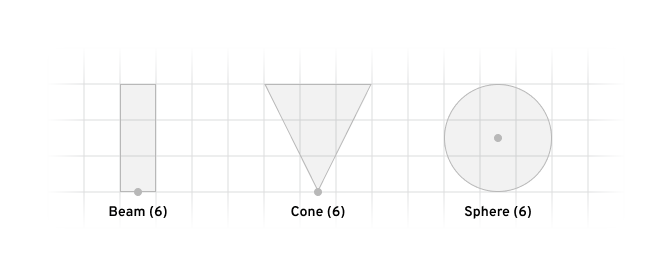
Using Your Imagination
If you aren’t using a battle map and miniatures, your first option for assessing who or what might be within a given area is to trust your intuition. Otherwise, you can estimate how many human-sized subjects the area might include using the following coarse-grained calculations as a starting point.
- Beam: Divide size by 10 (round up).
- Cone: Divide size by 5 (round up).
- Sphere: Divide size by 2 (round up).
Chemicals, Energies, and Forces
The longer you play, the more likely it is that your character will contend with an environmental hazard. The following represent common threats. While not comprehensive, they can be used as a basis for modeling other dangerous phenomena your character may be exposed to.
Cold
Precipitously low temperatures can be just as deadly as high ones. Liquids may freeze, plants may wither and die, machinery may seize, and electrical devices may malfunction. When you experience blasts of extreme cold, roll:
[> Target] where Target reflects how hard the blast is to avoid or mitigate
If you fail, you may…
- Take Stress or Trauma consistent with the cold’s damage factor (e.g., 1×).
- Be subject to Constraints such as Frostbit or Hypothermic.
Corrosives
Acids and other corrosive substances eat into materials, causing severe chemical burns if they come into contact with flesh. Splashes leave surfaces pitted and scarred, while larger volumes can burn straight through items, including body armor. If you’re exposed to a corrosive substance, roll:
[> Target] where Target represents how difficult it is to avoid being burned
If you fail, you may…
- Take Stress or Trauma consistent with the chemical’s damage factor (e.g., 1×).
- Be subject to Constraints such as Blistered or Disfigured.
Electricity
Naturally occurring electrical phenomena include static electric discharge and lightning (a form of plasma). Electricity can short out devices, destroy metal firearms, set off ammunition, and ignite flammable material. Strong electrical current can cause cardiac arrest, burns, and other tissue damage (including to internal organs), as well as painful muscle spasms severe enough to dislocate joints and break bones. If you come into contact with an electrical current or are struck by a discharge, roll:
[> Target] where Target reflects how hard the energy is to avoid or mitigate
If you fail, you may…
- Take Stress or Trauma consistent with the energy’s damage factor (e.g., 1×).
- Be subject to Constraints such as Fatigued or Memory impaired .
Heat
Fire and scorching or scalding heat can be painful at even low intensities, and lethal at higher ones. Intense heat or persistent open flames can ignite flammable material and set off ammunition. Burning objects usually emit smoke and fumes, which may trigger respiratory issues, oxygen deprivation, or both, especially in enclosed spaces. When you encounter significant heat or flames, roll:
[> Target] where Target reflects how hard the effect is to avoid or mitigate
If you fail, you may…
- Take Stress or Trauma consistent with the heat source’s damage factor (e.g., 1×).
- Be subject to Constraints such as On fire or Scalded.
- Be subject to ongoing damage if you catch fire yourself.
Impact
If you fall from a height or something heavy falls on you, you may be injured by the impact. Common injuries include traumatic brain injuries, spinal cord damage, broken bones (particularly in the wrists, ankles, hips, and spine), and internal organ damage.
[> Target] where Target equals the number of meters fallen
If you fail, you may…
- Take 4×Stress.
- Be subject to Constraints such as Fractured ankle or Concussed.
Toxicants
Both synthetic poisons and naturally occurring toxins and venoms can injure, sicken, or kill you —— whether injected, absorbed through the skin, ingested, or inhaled. When you’re exposed to a toxicant, roll:
[> Target] where Target reflects how hard the toxicant is to avoid or mitigate
If you fail, you may…
- Take Stress or Trauma consistent with the toxicant’s damage factor (e.g., 1×).
- Be subject to Constraints such as Nauseated or Hallucinating.
- Be subject to ongoing damage until the toxicant clears your system.
Survival
You can’t survive long without air, food, water —— or, in certain conditions, shelter. And to function effectively regardless, you must get adequate sleep.
Air
Assuming you’ve had time to inhale fully, you can hold your breath for:
(2 × Competence) + 5 Rounds
After this period, on the start of your Turn each Round, roll:
[> Target] where Target is ±0 + 1 for each subsequent Round
If you fail:
- Take 1 threshold of Stress (typically 5).
- If you reach or exceed your Maximal Stress threshold and you still aren’t breathing by the end of your Turn, you fall Unconscious and begin Suffocating.
- At the end of each subsequent Turn while you are Suffocating, you automatically take 1 threshold of Trauma every 30 seconds until you are dying.
Food
You need to eat about 500 grams of food per day. You can go without food for 4 days before you begin Starving. At the end of the fourth day and every 4 days thereafter, roll:
[> Target] where Target is ±0 + 1 for every 4 days past the fourth
If you fail:
- Take 1 threshold of Stress (typically 5).
- If you reach or exceed your Maximal Stress threshold, you become Incapacitated.
- At the end of each subsequent day while you are Incapacitated, you automatically take 1 threshold of Trauma until you are dying.
If you consistently eat half as much —— 250 grams per day —— start rolling after 8 days instead of 4; thereafter, roll and increase the Target every 8 days instead of 4.
Water
You need to drink about 3 liters of water every day, or twice that in hot weather. When you don’t drink enough water for a full day, you become Dehydrated.
At the end of the first day and every subsequent day with inadequate water, roll:
[> Target] where Target is ±0 + 1 for each day past the first
If you fail:
- Take 1 threshold of Stress (typically 5).
- If you reach or exceed your Maximal Stress threshold, you’re Incapacitated.
- At the end of each subsequent day after becoming Incapacitated, you automatically take 1 threshold of Trauma until you are dying.
If you consistently drink half as much —— 1½ liters per day —— start rolling after 2 days instead of 1; thereafter, roll and increase the Target every 2 days instead of 1.
Shelter
If you’re underdressed and unsheltered in harsh environmental conditions, you become Exposed. At the end of the first 15 minutes and every 15 minutes thereafter, roll:
[> Target] where Target is ±0 + 1 for every 15 minutes past the first 15
If you fail:
- Take 1 threshold of Stress (typically 5).
- If you reach or exceed your Maximal Stress threshold, you’re Incapacitated.
- At the end of each subsequent 15 minutes after becoming Incapacitated, you automatically take 1 threshold of Trauma until you are dying.
Sleep
If you go 24 hours without sleeping at least 6 hours, you become Sleep-Deprived. At the end of the first 24 hours and every 12 hours thereafter, roll:
[> Target] where Target is ±0 + 1 for every 12 hours past the first 24
If you fail:
- Take 1 threshold of Stress (typically 5).
- If you reach or exceed your Maximal Stress threshold, you fall Unconscious.
- After falling Unconscious, you recover normally (see Resting, above) and you will be able to regain consciousness once you reduce Stress below your Maximal Threshold.
If you consistently sleep half as much —— 3 hours per day —— start rolling after 48 hours instead of 24; thereafter, roll and increase the Target every 24 hours instead of 12.
Non-Player Characters
Whether you’re talking about an innocent bystander, a fellow adventurer, or a reclusive cryptid, all non-player sentient creatures are characters whose relevance to the story can be categorized as either peripheral, minor, major, or principal.
Peripheral
The vast majority of people and creatures who inhabit any story world will be nameless and, more or less, faceless. When your Guide describes these characters, they do so in order to provide detail and texture to enhance the immersion of a scene.
Amidst the visual spectacle, the market resonates with a cacophony of sounds. Traders call out their wares in melodious pitches, bargaining banter fills the air, and street musicians add a rhythmic backdrop.
Minor
When you interact with a non-player character, they may not have a name. But your Guide should prep a description, a Concept, a Target (i.e., their Core Competence), plus Stress and Trauma thresholds ranging from [t = 1] to [t = 3] (e.g., 0 Minor, 2 Moderate, 4 Serious, 6 Severe, 8 Critical, and 10 Maximal —— they won’t last long in a fight).
Doorman
The doorman adjusts his cap, one eye half-closed from a healing bruise. “No entry past midnight,” he mutters, voice gravel-thick with smoke and disillusion.
Neck like a piling, arms crossed like shutters in a storm, the doorman watches from beneath a steel-gray brow. He doesn’t speak unless someone’s already bleeding… or about to be.
- Ex-boxer turned bouncer. Trusts no one after midnight.
- Target: +2
- Stress: 0 Minor … 15 Maximal, Trauma: 0 Minor … 15 Maximal
Major
When you form or already have a relationship with a character —— be it familial, friendly, professional, adversarial, or otherwise —— they deserve a name, a Concept and a Risk plus maybe one other Constraint, possibly an Exception, Competence scores, as well as Stress and Trauma thresholds of [t = 3] or [t = 4].
Sylene Awn
Sylene leans across the battered worktable, ink-stained hands fidgeting with nervous energy. “If you want the seal broken, I’ll need a day, a fire opal, and absolute silence.”
Thin, quiet, and frazzled, Sylene wears a coat patched with silk and mesh, its hem dusted with ash. Her pale eyes watch something beyond the moment, her speech seemingly translating thoughts from a half-forgotten realm.
- Runesmith and reluctant arcanist. Will draw the attention of the Glyphguard.
- Read twice, act once: Sylene can reroll one failure when she interprets runes.
- Core: +4, Strong: +2, Basic: ±0, Weak: -1, Marginal: -2, None: -3
- Stress: 0 Minor … 15 Maximal, Trauma: 0 Minor … 15 Maximal
Principal
When a non-player character is a close ally or pivotal foe, they deserve a full character sheet —— Constraints, Exceptions, and Competence scores, along with Stress and Trauma thresholds of [t = 4] or [t = 5] (or higher, if they’re particularly tough).
Captain Garen Lhoric
Captain Lhoric stands on the observation deck, resolute as ever despite the distant crash of cannon fire. His coat is buttoned to the throat, his gaze fixed on the horizon where dawn is breaking faintly. “We secure the artifact,” he says quietly, “or die trying.”
Tall and lean with a faint scar across his left brow, Captain Lhoric maintains a ramrod-straight posture in spite of his old wounds. Close-cropped silver hair and weathered, dark-gold skin speak to years spent under harsh suns and harder commands. His uniform, while immaculate, bears the wear of countless deployments.
- Faith-shaken veteran officer. Deeply loyal to the rebellion, even though he feels the cause is lost. Carries a locket no one has ever seen him open. His past with the Ashen Hand may resurface.
- Dauntless. Lhoric is immune to fear when in command. Selfless. Once per Round, when Lhoric defends others, he takes +2 Ready.
- Core: +6, Strong: +4, Basic: +2, Weak: -1, Marginal: -2, None: -3
- Stress: 0 Minor … 25 Maximal, Trauma: 0 Minor … 25 Maximal
Every Threat’s a Character
You can represent almost anything in a TZER0 game world using the same essential elements that define characters. When a threat is more than a mere obstacle, you can leverage these elements to systematically define it.
- Description: Details that create a mental image of the threat
- Constraints: Free-form descriptors that reveal key facts about the threat
- Exceptions: Predetermined effects that come into play under specific conditions
- Competence: The threat’s ability to counter your efforts and act against you
- Edge: A pool of points the threat can use to influence the game
- Stress and Trauma: The threat’s damage thresholds
- Materiel: Physical, financial, and other tools integral to the threat or used by it
Of course, you will pick and choose the elements that make sense for each threat, and you may think about some elements using a different name (e.g., Actions instead of Materiel, Target instead of Competence, Reputation instead of Stress, and so forth).
Environmental Example
The Iron Rain
When the sky goes red and the clouds thicken with a metallic shimmer, survivors know to seek shelter. The Iron Rain falls in brief, deadly torrents —— accelerated by high-altitude charge differentials, needle-fine metal shards hurtle to the earth, shredding anything caught in the open.
Constraints
- Lethal atmospheric event. The Iron Rain isn’t just weather —— it’s a weaponized storm caused by a heretofore unknown ecological collapse or rogue technology.
- Predictable only in hindsight. Meteorologists and augurs alike fail to predict its arrival with any consistency.
Effects
- Shelter or suffer. When the Rain falls, everyone and everything in a 3-kilometer radius is imperiled. Characters must immediately roll [> +4] or suffer 2× Trauma.
Faction Example
Yukon FR-X
Yukon FR-X was founded by US separatist expats in Vancouver, British Columbia in the late 21st century, ostensibly to protect US immigrants from other Vancouver gangs, such as the Bacon Brothers and Shi Fong. Over time, its activities diversified beyond mere self-defense to encompass various criminal enterprises, including drug and arms trafficking. Since its inception, Yukon FR-X has demonstrated a significant capacity for expansion, spreading across the Northwestern United Sates, Alaska, British Columbia, and the Yukon.
Constraints
- Territorial street gang infamous for brutal violence. Yukon FR-X protects their territory through violence and murder. Members are known to be barbarically merciless.
- Network of loosely affiliated cells. While cells have traditionally operated with a degree of autonomy, there is evidence of increasing coordination and direction from leaders based in the US.
- Engaged in diverse criminal enterprises. While primarily concerned with arms and drug trafficking, any given cell will command multiple other illicit activities.
- Allied with the Northwest Liberation Front. Stemming from an early need for protection within the US federal prison system, Yukon FR-X and the Front have a strong, mutually beneficial relationship.
- Targeted by rivals and law enforcement alike. Wary of Yukon FR-X’s savagery, their adversaries trust the adage “the best defense is a good offense.”
Exceptions
- Their reputation precedes them. When Yukon FR-X’s involvement becomes known, affected parties may hesitate or back down. Once per session, treat any hostile faction or civilian group as having a relevant Constraint (e.g., Unwilling to escalate or Fearful of Yukon FR-X).
- Anything for a neighbor. Once per session, the organization can activate local affiliates. Introduce a narrative Constraint representing actionable intelligence, surveillance, or logistical support provided by another cell in proximity.
- Guerrilla tactics built this house. Once per session, Yukon FR-X can instigate coordinated chaos (e.g., a riot, blackout, or unrelated hit). Establish a narrative Constraint reflecting confusion, misdirection, or delayed responses by authorities and rivals alike.
Cryptid Example
The Hollow Maw
A towering, emaciated creature resembling a withered, bipedal elk-man with antlers of bone and rusted metal, the Hollow Maw roams ancient forests near long-abandoned bunkers and crash sites. Its skull-like face splits open into a void of whirling static and harsh whispers when it feeds —— not on flesh, but on memory and identity. Those who survive say only that “something was missing afterward.”
Constraints
- Born of wreckage and war. The Hollow Maw is rumored to have emerged from failed military experiments in the mid-21st century.
- Warden of the wastes. Haunting overgrown exclusion zones, the Hollow Maw defends its territory as though fulfilling some buried purpose.
- Recognized by silence. Animals fall quiet. Technology malfunctions. Even radio static may go flat. These signs often precede an encounter.
- The hunted becomes the hunter. It does not chase its prey —— it waits, patiently. It watches. It selects.
Exceptions
- Memory corrosion. Once per encounter, the Hollow Maw imposes a Constraint such as Fragmented Self or Unable to recall the recent past on anyone it can see. Although eventual recovery is possible, this power can’t be resisted in the moment.
- Anomalous silence. Once per scene, the Maw can suppress wireless comms within Sphere (18) —— radios, drones, and sensors malfunction for [d0 + 6] Rounds.
- Unplaceable presence. Once per session, the Hollow Maw can rewrite history to alter its presence in a scene retroactively, as though the characters had never seen it or had always been watched by it.
- Natural armor. The Maw is tough enough to withstand attacks as if it were wearing Class 2 armor.
Stats
- Target: +4
- Stress: 0 Minor … 40 Maximal, Trauma: 0 Minor … 40 Maximal
Relic Example
The Vigilant Chain
Constraints
- Linked to an ancient religious order. Forged by a long-vanished caste of devout sentinels, the Chain remembers oaths broken centuries ago —— and sometimes whispers them to its bearer in moments of crisis.
- Cursed. Once attuned, the Chain cannot be separated from its bearer except by powerful magic, their death, or when another entity attunes to its powers.
Exceptions
- Righteous in trust. Glows faintly in the presence of broken vows or oaths.
- Divine agent. When brandished with conviction, the runes etching the Chain’s links glow with celestial energy. Roll [> ±0]. Treacherous or unholy creatures whose Target or Competence is less than your Net Effect cannot willingly be within 8 meters of you as long as you continue to brandish the Chain.
- Never alone. Once per scene, the Chain animates to defend the bearer or a nearby ally, allowing them to reroll one failed defense check —— whether physical or supernatural.
- Binds those who would abandon the fight. The Chain reacts unfavorably if its bearer attempts to flee an opponent or if they don’t take the opportunity to defend those who deserve to be defended. Roll [> +8], or you’re forced to stand your ground.
Putting it all together…
A Sample Tactical Encounter
The Setup
The characters are escorting Shin, a high-value corporate defector, to a safe house on the outskirts of New Barcelona. As time is of the essence, and wanting to avoid notice, they have taken a shortcut through the city’s predawn backstreets. Unfortunately, Shin’s drug addict ex-boyfriend, desperate for his next fix, tipped off Black Company (a mercenary combine working for her former employer). Five of their operatives have laid an ambush for the group in a rain-slicked alley along their route.
The Player Characters
Fox (Played by Juanito)
- Silver-tongued infiltrator. Roguish, smooth-talking negotiator skilled in stealth and deception.
- Phantom protocol. Cybernetics flaring with painful static, Fox can take 1 Stress per Round to render himself invisible to all surveillance devices. Precognitive vibes. He takes +2 to anticipate hidden threats. Tactical architect. If Fox has time to case a location, he can take +2 to any Test related to his research.
- Core: +2, Strong: +1, Basic: ±0, Weak: -1, Marginal: -2, None: -3
- Stress: 0 Minor … 25 Maximal, Trauma: 0 Minor … 25 Maximal
- Materiel: Class 2 Armor —— ; Beretta PX4 Storm —— ; Push Dagger ——
Sparks (Played by Holly)
- Ghost in the machine. Tech-savvy hacker and demolitions expert.
- Always a workaround. Sparks can reroll any Test —— as long as she takes a different approach. Arm the EMP. She can expend 1 Edge to enhance ordinary explosives to deliver a brief burst of electromagnetic energy, frying devices within a Sphere (10) area. Surgical script. Sparks takes +2 to avoid detection while breaching any computing device or network.
- Core: +2, Strong: +1, Basic: ±0, Weak: -1, Marginal: -2, None: -3
- Stress: 0 Minor … 25 Maximal, Trauma: 0 Minor … 25 Maximal
- Materiel: Class 2 Armor —— ; Brügger & Thomet MP9 —— ; Sniper MAMU Fixed Blade —— ; Cyberdeck; Demolitions Toolkit
Ursa-May (Played by Karina)
- Submissionatrix. Brazilian jiu-jitsu enforcer with a black Velcro patch affixed to her plate carrier that reads in bold, yellow capitals: HUG DEALER.
- Clap back. If Ursa Exceeds a hand-to-hand defense Test, she can immediately roll a Fast (2) counterattack without expending Ready. Meat shield. If she Exceeds any defense Test, she can pull a nearby opponent in front of the incoming attack. Wheel and deal. If Ursa Exceeds a Full (6) grappling attack and she forgoes her Move (0) action, she can immediately roll a second Full (6) attack Test to throw her opponent violently into a nearby adversary without expending Ready.
- Core: +2, Strong: +1, Basic: ±0, Weak: -1, Marginal: -2, None: -3
- Stress: 0 Minor … 25 Maximal, Trauma: 0 Minor … 25 Maximal
- Materiel: Class 2 Armor —— ; Throwing Knives (3) —— ; Knucks ——
The Adversaries (Run by Iggy, the Guide)
Warhound
- Black Company enforcer. Hulking cybernetic sociopath bred for kill missions.
- Reinforced wrists. Warhound can wield his K-BLAM in a single hand without worrying about the recoil. Relentless. Once per Round, when Warhound Exceeds an attack Test, he takes +2 Ready. Thyreophorum. Warhound’s head and body are surgically laminated with armor plates, calling to mind the osteoderms of an Ankylosaurus (Armor: 2).
- Core: +4, Strong: +2, Basic: ±0, Weak: -1, Marginal: -2, None: -3
- Stress: 0 Minor … 25 Maximal, Trauma: 0 Minor … 25 Maximal
- Materiel: K-BLAM Short-Barrel Shotgun —— ; Razor-Wire Club ——
Minor Threats
- Black Company foot soldiers (4). Frontline henchmen recruited from the streets to engage in intimidation, kidnapping, murder, and other criminal activities on behalf of Black Company leadership.
- Core: ±0
- Stress: 0 Minor … 10 Maximal, Trauma: 0 Minor … 10 Maximal
- Materiel: Rhino 30DS X (1 threat) —— ; Steel Pipe (3 threats) ——
The Encounter
Constraints
- Industrial afterglow. Sparsely lit, illuminated mainly by the cloud-reflected neon lights of the adjoining high street.
- Lousy with debris. Lined with overflowing dumpsters, swollen plastic bags, and loose refuse.
- Piso mojado. Slick with rainwater and assorted urban slime.
Determining Surprise
As the characters approach the Black Company ambush, Iggy describes the scene while he writes Constraints on index cards. Then he calls for an awareness Test [> +4]. Fox Succeeds (Juanito adds +2 Core and +2 Precognitive vibes to his +1 roll versus the +4 Target). Sparks Qualifies (Holly adds +1 Strong to her +3 roll). And Ursa-May Tanks (Karina adds +1 Strong to her -1 roll).
Iggy: As you turn down yet another alley, Fox, the hair on the back of your neck bristles. Something’s wrong. You can feel it.
Juanito (Fox): I slow my pace and raise my left hand as a warning to the rest of the team.
Iggy: Okay, Fox’s raised hand cues everyone to be on guard. Ursa, you Tanked, but Fox’s warning is effective so just take Surprised: -2 Next instead of forfeiting actions on your Turn.
Karina (Ursa-May): Before proceeding further into the alley, can I wave Shin to a safer position behind the closest dumpster?
Iggy: Sure, she scrambles to crouch behind the scuzzy, blue-painted steel container amidst overfull plastic trash bags and other waste. In fact, it makes sense that directing Shin hampers your reaction time, which also explains your -2 Next. Everyone —— roll Initiative.
Initiative Scores
- +2 Fox: Juanito adds +2 Core to his ±0 roll
- +1 Ursa-May: Karina adds +2 Core and -2 Next to her +1 roll
- ±0 Sparks: Holly adds +1 Strong to her -1 roll
- +4 Warhound
- ±0 Minor Threats
Round 1
Iggy: Two figures emerge from the haze of steam and shadows in front of you. The one on your left, their massive silhouette disrupted by angular protrusions, levels a sawed-off shotgun in one hand and grips a razor-wire club in the other. The figure on your right is unremarkable save for a stainless blunt-nose revolver held in a palm-down side grip. The larger one growls, “Our patron is worried about their cherished employee, who you lot have spirited away in the dead of night. If it’s ransom you’re after, you’re out of luck. But if you let her go now, we can conclude our business peaceful-like.”
Fox, it’s your Turn first. What do you do?
1. Fox’s Turn
Juanito (Fox): Even if the numbers are in our favor, I don’t like the looks of the big guy. I speak to the others under my breath, “Maybe we should go back the way we came, find an alternate route.”
Iggy: Glancing behind you quickly, you see the alley’s entrance is blocked by three individuals —— each one casually tapping a steel pipe in the open palm of their free hand.
Juanito (Fox): “Ursa-May, looks like you have some friends who want to play.” I take aim at the big one in front of me.
Iggy: Unfortunately, with a +4 Initiative score, he gets his Fast (2) shot off first. [Ready drops from 6 to 4.] Meanwhile, his companion is locking onto Sparks. Roll [> +4] to defend.
Juanito (Fox): d0 is ±0, with a +2 Competence for a Net Effect of -2. Botch.
Iggy: You stagger to one side as the big one’s shotgun lights up the alley with a jet of flame. The shotgun slug, with v. Armor: +1, punches through your body armor. Take 6 Trauma. He adjusts his aim slightly and takes another shot. [Ready drops from 4 to 2.] Roll to defend.
Juanito (Fox): d0 is +4, with a +2 Competence is +6; +2 Net Effect. My turn! As I come out of a combat roll, I pull the trigger on my Beretta twice for a double tap. [Ready drops from 6 to 3.] First d0 is +2 —— Qualify. Second is +3 for a Net Success of +1.
Iggy: [Accounting for Warhound’s armor…] You see the puff of an impact, but it doesn’t have much effect. You have the Initiative —— unless you want to yield it for +2 Next.
Juanito (Fox): I’ll do that.
Iggy: He fires another round. [Ready drops from 2 to 0.] Roll to defend.
Juanito (Fox): d0 to defend is +4. Succeed! [Takes the Initiative.] Another double tap! [Ready drops from 3 to 0.] d0 is +3, with a +2 Competence and +2 Next is +7; Net Effect is +3.
Iggy: Another impact puff. This time, the big guy grunts softly. [Warhound takes 3 Trauma.]
Juanito (Fox): Second shot —— d0 is +2, with a +2 Competence is +4. Qualify.
Iggy: Ursa’s turn.
2. Ursa-May’s Turn
Karina (Ursa-May): I move to engage the three pipe-wielding toughs.
Iggy: Their weapons give them Reach advantage —— +2 Initiative score, +2 to defend. They fan out slightly, attempting to flank you. [Working as a unit, they have 9 Ready and the acting tough takes +2.] Roll [> +2] to defend yourself. [Unit Ready drops from 9 to 7.]
Karina (Ursa-May): d0 is +2, with a +2 Competence and Surprised: -2 Next for a ±0 Qualify.
Iggy: They continue to press you. Roll [> +2] to defend. [Unit Ready drops from 7 to 5.]
Karina (Ursa-May): d0 is -4, with a +2 Competence is -2. -4 Net Effect —— Tank.
Iggy: One of the thugs connects. [Accounting for Ursa’s armor…] Take 2 Trauma. Emboldened, they advance, take +2 Next, and one sets up for a bigger swing. [Unit Ready drops from 5 to 3.] Roll [> +4] to defend against the setup.
Karina (Ursa-May): Rolling against the setup… d0 is +1. With +2 Competence, that’s +3. With a +4 Target? Botch. Against the swing… d0 is -3 with a +2 Target. -3 Net Effect.
Iggy: The bigger swing (2×) lands awkwardly. Take 2 Trauma (after armor). [For a total of 4 so far this Turn.] [Unit Ready drops from 3 to 1.] You have the Initiative, Ursa-May.
Karina (Ursa-May): “Who wants a hug?” I use a Full (6) action to grab the nearest bastard… d0 is +2 with a +2 Competence, and I’ll expend Edge on Submissionatrix and Piso mojado for an additional +4. Against a defensive Target of +4, Net Success is +4. [Ready drops from 6 to 0.]
Karina (Ursa-May): Time to Wheel and deal! Because I Exceeded my grappling attack, I can immediately roll a second Full (6) attack.
Iggy: Roll [> +2].
Karina (Ursa-May): d0 is -2 with a +2 Competence, which is a Net Effect of -2. No luck.
Iggy: Still… You wrap an arm around your opponent and lever him over your hip, sending him flying toward his companions. [Ursa’s Exceed attack deals 20 Stress, enough to incapacitate two of her opponents.] You send two of your attackers careening into a wall. They slump unconscious from the impact into the litter below. But because your last attack Botched, you yield the Initiative on your Turn next Round.
Sparks, it’s your Turn.
3. Sparks’s Turn
Iggy: The tough with a revolver has you in his sights. Because your Initiative scores are tied (±0, ±0), you have the Initiative —— if you want it. Or you can yield it and take +2 Next.
Sparks (Holly): I’ll take the +2 Next. I’m going to focus my efforts as much as possible on the big fella.
Iggy: Okay, the one with the revolver pulls the trigger twice in rapid succession for a double tap. [Ready drops from 6 to 3.] Roll [> ±0] twice to defend.
Sparks (Holly): d0 is +2 with +1 Strong Competence, which is a Net Success of +3. Second d0 is -3 with +1 Strong —— a Net Failure of +2. I’m going to expend Edge on Industrial afterglow because the lighting makes it harder to aim, bringing that result up to a ±0.
Iggy: You hear the second bullet zing past your ear. With one Succeed and a Qualify, you take the Initiative.
Sparks (Holly): Cool, I’m going to kick a bag of trash toward the big guy’s head, hoping to divert his attention from my real attack.
Iggy: Do you think this is a Strong or Basic Competence for Sparks?
Sparks (Holly): Basic. Sparks is definitely better with a gun, even better with explosives.
Iggy: We’ll call that a Fast (2) action. [Ready drops from 6 to 4.] Roll [> +2]. Warhound may be a combat monster, but he’s relatively easy to deceive.
Sparks (Holly): d0 is +3, with a ±0 Competence for a Net Effect of +1.
Iggy: He takes a Distracted by detritus Constraint. You have 1 Free Edge.
Sparks (Holly): Now for a long burst! [Ready drops from 4 to 1.] d0 is -1, with a +1 Strong Competence —— versus a -4 firearm technique Target —— for a Net Effect of +4. But I’m going to apply that Free Edge and expend my own Edge on Distracted by detritus to bring the total up to +8 for the burst; I apply everything against the biggun’s +4 defense.
Iggy: You hit him center mass, staggering him. [After armor, Warhound takes 6 × 3 = 18 Trauma for a total of 21 so far this Round.]
Iggy: You only have 1 Ready remaining. Can you do anything with that?
Sparks (Holly): I can’t think of anything.
Iggy: Your friend with the revolver still has enough Ready for another attack. Roll [> ±0] twice to defend against his double tap.
Sparks (Holly): Defending… d0 is ±0, with a +1 Strong for a Net Effect of +1. Second d0 is +1 with a +1 Strong —— a Net Success of +2. Yes!
Round 2 and Beyond…
The fight continues. Warhound, the minor threat with a revolver, and one of the minor threats with a steel pipe are all still standing. Round 2 starts on Fox’s Turn; he has the Initiative (because he Qualified his last double tap shot).
09 Supernature
Some feats and faculties are strange beyond the understanding of natural philosophy or physical science. Your character’s Supernature is the animating principle that unites their material self with a spectrum of arcane, astral, cryptic, demonic, divine, eldritch, esoteric, metaphysical, mystical, numinous, occult, paranormal, sacred, spectral, sublime, taboo, transcendental, transdimensional, uncanny, and weird phenomena.
Manifesting
When you Manifest, you use your Supernature to materialize, manipulate, and exploit paranormal phenomena to achieve a specific goal.
What Can Manifesting Do?
Even if outwardly it might seem more impressive, Manifesting is not necessarily more effective than any comparable mundane effort. Still, Manifesting excels in versatility and power. It takes advantage of cryptic loopholes in physics to hack the foundations of the universe and warp the fabric of reality. It makes the inconceivable feasible and brings otherworldly wonders within reach. As long as a desired effect squares with your game’s fiction and you have the time, energy, and Competence, you can Manifest just about anything.
Constraints
The Expanse is beyond measurement, calculation, and conception.
At its most potent, Manifesting implies forces so irresistible and terrifying they transcend the limits of mere mortal apprehension. Practitioners describe the domain where these and lesser phenomena originate as The Expanse. Whenever you attempt to Manifest an effect —— whether intentionally or unwittingly, successfully or unsuccessfully —— you must journey into The Expanse to do so. The more powerful the effect, the deeper you must venture. Which is why Gestures, Incantations, and Offerings are so valuable: they anchor and reinforce your effort in the material world, helping you face The Expanse without becoming irretrievably lost to it.
The Expanse = Supernature ∞ Supernature = The Expanse
The Expanse comprises all existence as far back as its earliest beginnings. It underpins, surrounds, and pervades reality. Everything in the material world has a Supernature, which is both a fundamental, structural feature of The Expanse as well as a bidirectional channel between the physical and the metaphysical. When you travel The Expanse, you journey inward through your Supernature to this infinite totality.
The Principle of Intrinsic Aspects: When Manifesting violates an intrinsic aspect of reality, the effect must be deliberately maintained or reality will revert to its natural state.
The durability of Manifested effects depends on intrinsic aspects of reality. Inherently momentary effects (like an electrical discharge) can’t be maintained. Ongoing phenomena that violate natural laws (like arcane light) must be maintained with concentration or with an infusion of supernatural energy. However, acts aligned with nature (like miraculous healing) are self-maintaining.
Worldbuilding
As a group, you should write narrative Constraints to further codify how Supernature and Manifesting function in your story world. For example, you might declare Life is for the living: not even magic can restore the dead to true life.
Who Can Manifest?
Your ability to channel your Supernature is…
- Established by a Constraint. Whether it’s the result of innate paranormality, revealed via a mystical connection to the divine, or understood through careful study and practice, your Supernature must be codified in a Constraint such as Ars Esoterica: I have knowledge, and my knowledge is power, more or less hidden until I choose to reveal it.
- Enabled by an Exception. You must take: I travel The Expanse. Because the Expanse is beyond measurement, calculation, and conception, when I Manifest a supernatural effect and roll a natural -5, I can’t return from The Expanse without repercussions.
- Exercised by Competence. Your ability to Manifest flows from your Constraints, the nature of your Manifestation, and the situation at hand. When it makes sense, subjects will defend against a Manifestation’s efficacy by means of their own Competence —— whether mental, physical, or metaphysical.
Constraints
The Six: Every time you Manifest an effect, you employ one of six Techniques.
The following Techniques can serve as hooks for Competence assessment and other mechanical or narrative texture.
- Bend: Generate illusory constructs; simulate sensory phenomena.
- Nudge: Discern and manipulate mental states; communicate telepathically.
- Port: Warp space-time and chance; transit distances and dimensions instantly.
- Sense: Augment perception; remotely perceive past, present, and future.
- Source: Exploit elemental energies, arcane powers, and unseen forces.
- Tend: Manipulate natural processes such as growth, healing, and mutation.
You sign every Manifestation. Like a fingerprint, your Supernature is uniquely your own.
Every effect you Manifest is imbued with subtle sensory qualities —— sights, sounds, smells, feelings —— reflecting your esoteric identity. Careful observation of Manifested phenomena can reveal you as the source. Even after an effect ends, skilled practitioners may be able to use traces of your Manifestation in the course of a forensic investigation.
Worldbuilding
Public laws, social norms, and personal codes of conduct dictate how and when you can Manifest, even if you might otherwise readily do so. Such Constraints can encourage membership in professional orders or secret societies, permit or prohibit specific kinds of Manifestations, and create opportunities for you and your Guide to expend Edge for narrative and mechanical advantages.
Likewise, your Concept affects what you can Manifest. A magus might command a broad range of thaumaturgic practices and phenomena even while some effects requiring spiritual inspiration remain forever out of reach. On the other hand, a warrior priest might be limited to effects within their divine patron’s domain. At the same time, a ranger or druid might consider how Manifesting aligns with their attunement to nature.
One-Off Effects
Your Concept or Hallmarks may suggest a limited Manifesting faculty —— a small number of predetermined effects, accessed without full or even conscious awareness of The Expanse.
Some of these effects can be codified as conventional Exceptions. Others are better treated as special-case Manifestations: write an Exception for each of these, granting +2 to Manifest a predetermined effect (see Effects × Spells, below).
Magic Items and Attunement
A magic item is an object imbued with one or more occult powers. To benefit from an item’s powers, the item must be in your possession and you must attune to each power independently. Mechanically, you assign Edge to gain access to one of the item’s Exceptions (see 08 Threats, Relic Example) —— exactly as you would assign Edge to write a new Exception (see 06 Edge, Writing New Exceptions).
Some magic items are Cursed, which means at least one of their embodied Exceptions is disadvantageous. You discover this only at the moment you try to attune to any of an item’s advantageous powers… at which point you automatically attune to all of its cursed powers (without assigning Edge). Attunement to a cursed item generally can’t be broken except by Manifestation, death, or when another entity attunes to its powers.
The Drill
Like any effort, Manifesting involves a Test to find out what happens, with a couple of key differences.
- Net Success is a currency. You can spend it to enhance aspects of your Manifestation, such as the size of its area of effect (cf. 07 Tests, Effort × Efficacy).
- Drain increases Net Effect. If your desired outcome requires more Net Success, you can trade Stress or Trauma for additional Net Effect.
When you decide to Manifest an effect, follow this procedure:
- Set a Target. Your Guide will work with you to set a Target based on your intent and specific Manifesting factors (such as Range and Scope), as well as any prevailing circumstances.
- Assess Drain. Roll [> Manifesting Target]. You must Succeed or Exceed to Manifest anything more than stray, superficial ephemera. Whether your Test is successful or not, you can improve your result by expending additional effort in the form of Drain: take 1 Stress or Trauma for each +1 added to your Net Effect.
- Resolve the Manifestation. Allocate Net Success, if any, to aspects of your Manifestation as you see fit. Successful or not, your Guide will explain how the scene evolves, often relying on you to portray your character’s effort and its impact.
Resolving Non-Player Manifestations
Your Guide does not roll Tests (see 07 Tests, Interpreting Tests). They can resolve a non-player Manifestation by subtracting Manifesting Target from Competence (taking Drain if doing so is necessary for positive results). However, someone still must make a Fate Roll for the Manifestation —— if the result is a natural -5, they “…can’t return from The Expanse without repercussions.”
When you are the unwilling subject of a Manifestation, you can defend yourself by rolling [> Allocated Efficacy] (see Allocating Net Success, below).
Setting a Target
Your Guide will set Manifesting Targets based on the kind of resistance you’re facing: obstacles, opponents, or, on rare occasions, other Players. Every Manifestation Target and Test are further influenced by the following considerations.
Factors that affect your Target include…
Action. How quickly will you attempt to Manifest your effect?
- Full (6) × 3
- Full (6) × 2
- Full (6)
- Half (3)
- Fast (2)
- Free (0)
Typically, a Free (0) action is, like a flinch, too reflexive to bring Offerings into play.
Range. How far away do you want your effect to materialize?
- Self (area effects emanate from…)
- Touch
- Point-Blank (2)
You must Qualify an unarmed attack to touch an unwilling subject.
Scope. How many subjects or how wide an area does your effect incorporate?
- One subject
- Two subjects
- Beam (2)
- Cone (2)
- Sphere (2)
Modifiers that affect your Test include…
Gestures. Will you move noticeably while Manifesting (e.g., gesticulate enigmatically, play an instrument, dance ceremonially)?
- No
- Yes
Incantations. Will you vocalize assertively while Manifesting (e.g., intone cryptically, speak plainly, sing, chant, or pray)?
- No
- Yes
Offerings. Will you aid your Manifestation with items or substances imitating or reinforcing your intended effect?
- No
- Yes
Ongoing effects. How many effects are you maintaining with concentration when you roll your Manifesting Test?
- None
- Per ongoing effect
Concentration adds -2 per ongoing effect to all Tests, not just Manifesting.
Allocating Net Success
By spending Net Success to upgrade aspects of your Manifestation, you can…
Set efficacy. You must allocate at least +1 Net Success to Manifest your core effect. You can allocate more if it scales (e.g., as damage does) or if Exceeding is relevant.
Obfuscate your signature. Witnesses and would-be investigators take -1 to identify you as the source of a Manifestation per Net Success spent to hide its origin.
Expect to Sustain. Earmark Net Success to extend an ongoing effect without concentrating (see below). Take +1 Next Sustain per +1 Net Success held in reserve.
Incorporate a secondary effect. Do you want your effect to include a Constraint?
- No
- Set up a relevant Constraint
- …with 1 Free Edge
- …with 2 Free Edge (maximum)
Extend Range. Do you want your effect to materialize at a greater distance?
- No
- Per 2× gain up to Longest (256)
- Per additional 256 meters
Expand Scope. Do you want your effect to include more subjects or a wider area?
- No
- Per subject beyond two
- Per 4-meter size increment
Note: Effects can include bespoke allocation options (see Grimoire, below).
Ongoing Effects
As The Principle of Intrinsic Aspects asserts, some effects materialize for a brief moment and then end immediately. Others alter reality permanently. But ongoing effects only persist as long as you maintain them.
Concentrating
By default, ongoing effects last as long as you Concentrate. If your focus is disrupted, reroll your Manifesting Test for each ongoing effect. If you Botch or Tank, the effect ends immediately unless you take Drain to raise your Net Effect.
Sustaining
As a Free (0) action once per Turn, you can attempt to Sustain one ongoing effect. Reroll your Manifesting Test. If you Botch or Tank, the effect ends immediately unless you take Drain to raise your Net Effect. If you Qualify, you must continue to concentrate to maintain your effect. Otherwise, allocate Net Success to Sustain it.
- 1 minute
- 10 minutes
- 30 minutes
- 1 hour
- 2 hours
- 4 hours
- 8 hours
- 16 hours
- 24 hours
Triggered Effects
A Trigger establishes a primary effect you wish to Manifest while stipulating observable conditions that will activate the effect if, and only if, those conditions are met.
The Drill
Your Competence for Manifesting a Trigger may differ from your Competence for Manifesting its primary effect (e.g., using the Sense Technique for the Trigger and Source for the primary effect), but the process is similar.
- State the conditions that will activate your Trigger and set a Target for it.
- Set a Target for your primary effect. Narratively speaking, you enact all the steps required to Manifest your primary effect when you set its Target. Note any modifiers (such as those resulting from Gestures, Incantations, and Offerings), which will apply to the Test you must roll when the primary effect’s potential energy is released in step (5).
- Roll [> Trigger Target] and assess Drain for the Trigger.
- Resolve the Trigger. Once Manifested, you must maintain your Trigger as an ongoing effect. Accordingly, you can drop it at any time or roll to Sustain it on your Turn. If your attempt to Manifest or Sustain your Trigger fails, or if your Trigger trips before you drop it, you must reckon with the potential energy released by your primary effect in step (5).
- Roll [> Manifesting Target] and assess Drain for your primary effect.
- Resolve the effect. If you no longer wish to Manifest it, you must Qualify your Test.
Interpreting Manifesting Tests
When you roll a natural -5 (even if your intended effect materializes), Botch, or Tank, your effort provokes supernatural backlash, corruption, distortion, or other anomalous effects. Your Guide will typically determine what happens, but they may invite you to help narrate the fallout.
Minor Manifesting Consequences
A minor consequence generates moderate instability or small unintended side effects. Your Manifestation fizzles, but reality shifts slightly. For example, your Guide might…
- Signal an imminent threat. Your Manifestation falters and cracks before it shatters, sending a pulse of arcane energy rippling outward. Any paranormally aware entities within Sphere (2 + 4 per Net Failure) know exactly where you are.
- Trigger a Next Modifier or Constraint (without Free Edge). Arcane forces whip you out of The Expanse. Take Disoriented: -2 Next.
- Mirror your action. As you work to bend a subject to your will, you can’t shake the sense that someone else is probing your own mind for vulnerabilities.
- Force you to make a difficult decision. Overwhelmed by eldritch energy, you can maintain control for only so long. When you finally succumb, the energy engulfs you or one of your nearby allies. Pick someone. They’re instantly transported to a random location you have visited recently.
- Reveal an obstacle. As you struggle to Manifest your effect, all of the doors leading out of the room slam closed and lock.
- Take something useful from you. As you lose control, reality tilts and warps. You blink, and the world resets. You can’t Manifest the same effect until you finish a short rest.
- Inflict Stress. Your mind is flooded with psychic energy. Take 1×Stress. Your Guide allocates Net Failure as if it were Net Success, increasing the damage factor if possible.
Major Manifesting Consequences
A major consequence destabilizes reality, generating powerful unintended supernatural effects. The resulting fallout threatens you and your companions. For example, your Guide might…
- Advance an immediate threat. Your Manifestation opens a transdimensional rift. A hostile entity steps out of The Expanse into the material world.
- Reinforce an existing threat. Every opponent within Sphere (2 + 4 per Net Failure) quivers briefly as it splits into two identical versions of itself. The duplicates last Net Failure Rounds before winking out of existence.
- Trigger a Constraint with Free Edge. Arcane energy escapes your control and envelops your body in bright shifting, swirling tendrils of light. Take Eldritch Aura with 2 Free Edge for Net Failure Rounds.
- Preempt your action. As you work to bend a subject to your will, you feel a tug in your own mind. Your subject tries to wrest control from you. Roll [> Net Failure] or they manage to turn your Manifestation against you.
- Force you to make a dramatic decision. Overwhelmed by eldritch energy, you can maintain control for only so long. When you finally succumb, the energy engulfs you or one of your nearby allies. Pick someone. They take 1×Trauma. Your Guide allocates Net Failure as if it were Net Success, increasing the damage factor if possible.
- Activate an obstacle. Spectral energy streams out of control from your body into the ground beneath your feet. Within seconds, a yawning chasm splits the earth, separating you from your allies… but not from your enemies.
- Take something vital from you. Something breaks inside you. For the next 24 hours, every time you Manifest, make a Fate Roll. If you Botch or Tank, you can’t Manifest the intended effect until you finish a long rest.
- Inflict Trauma. Your body is flooded with arcane energy. Take 1×Trauma. Your Guide allocates Net Failure as if it were Net Success, increasing the damage factor if possible.
Grimoire
A grimoire is a personal reference, workbook, and journal for studying esoteric topics, theories, and applications (see 10 Materiel, Toolkits). As a practitioner, you use your grimoire to preserve transcendental observations, record hypotheses for further investigation, document arcane experiments, and work out in detail how to Manifest various effects.
Effects × Spells
Once you have rigorously researched, developed, and tested an improvised Manifesting method, you can formulate it as a spell. In game terms, assuming you have sufficient Edge, you’re ready to write an Exception granting you +2 to Manifest the spell’s predetermined effect. Narratively, you inscribe a spell in your grimoire and commit it to long-term memory through meticulous study and meditation.
Use the following predetermined effects as spec’d or as templates for your own off-the-cuff Manifestations and written Exceptions.
Aegis
An invisible layer of spectral force shields you. Take +2 to defend yourself.
- Exceed: Take +4 to defend yourself.
- Botch: An invisible layer of spectral force restricts your mobility. Take a Hindered Constraint with 1 Free Edge, which ends when its Free Edge is depleted.
- Tank: Take Hindered with 2 Free Edge.
Augur
You grant a subject you designate the power to envision the immediate future without the need for conscious reasoning. Your subject takes an Insight Constraint with 1 Free Edge.
- Exceed: Your subject takes Insight with 2 Free Edge.
- Botch: You overwhelm your subject with a lack of confidence in their instincts. They take a Doubt Constraint with 1 Free Edge, which ends when its Free Edge is depleted.
- Tank: Your subject takes Doubt with 2 Free Edge.
Blink
You disappear into an ephemeral vortex of spectral soot, then reappear out of an identical vortex in an unoccupied space you can see within Range.
- Exceed: When you reappear, take Out of phase: +2 Next.
- Botch: You teleport to a random unoccupied space within [2^Net Failure] meters, whether you can see it or not, losing a useful piece of Materiel along the way.
- Tank: Teleport; but instead of losing a useful piece of Materiel, lose a vital piece.
Blur
A subject you touch appears as a spectral blur, taking +2 to defense, stealth, and similar Tests versus any opponent who relies on sight.
- Exceed: Your subject is so indistinct they appear to have little solidity. They take an Insubstantial Constraint with 1 Free Edge.
- Botch: Your subject is enveloped by a mantle of glowing ephemera. They take a Marked Constraint with 1 Free Edge, which ends when its Free Edge is depleted.
- Tank: Your subject takes Marked with 2 Free Edge.
Counterspell
When you see an entity start to Manifest an effect, roll to suppress their effect as a reflexive reaction. You must allocate sufficient Net Success to extend Range to reach your subject, who takes -1 per remaining Net Success to Manifest their intended effect.
- Exceed: Your subject takes -2 Next to Manifest the same effect.
- Botch: As you lose control, reality tilts and warps. You blink, and the world resets. You can’t Manifest Counterspell again until you finish a short rest.
- Tank: Something breaks inside your Supernature. Until the session ends, every time you Manifest, make a Fate Roll. If you Botch or Tank, you can’t Manifest the intended effect until you finish a long rest.
Damage
Blast, Bolt, Jet, Missile, Shockwave, and Smite channel destructive energy.
- Exceed: Take +2 Next:[same effect —— Blast, Bolt, Jet, Missile, Shockwave, or Smite].
- Botch: Your effect targets a random subject. Treat Net Failure as Net Success.
- Tank: Your effect targets everyone within Sphere (2 + 4 per Net Failure).
Blast
A ball of billowing arcane energy explodes from a point you designate within Range.
Bolt
A surge of crackling force flashes from your position in a direction you designate.
Jet
A stream of turbulent energy expands from your position in a direction you designate.
Missile
Multiple darts of arcane force streak from you toward targets you designate.
Shockwave
Concussive eldritch force explodes from your position in all directions.
Smite
Hissing arcane energy envelops your hand as you reach out to touch your subject.
Allocating Net Success for Damage
Set efficacy. Each affected subject takes damage when your efficacy exceeds their defensive Competence.
Set damage factor. To calculate damage, multiply allocated Net Success by…
- 1×
- 2×
- 3×
- 4×
- 5×
Incorporate a secondary effect. To add a Constraint (e.g., Corrosive, Incendiary, or a similar elemental effect) to your primary effect, allocate 2 Net Success.
Deal Stress. Reclaim +1 Net Success if your effect deals Stress instead of Trauma.
Detect Magic
You sense arcane phenomena in your field of vision within your effect’s Scope.
- Exceed: Your senses extend beyond your field of vision, detecting phenomena within Scope on the far side of intervening barriers such as doors and walls.
- Botch: As you lose control, reality tilts and warps. You blink, and the world resets. You can’t Manifest Detect Magic again until you finish a short rest.
- Tank: You can’t Manifest Detect Magic again until you finish a long rest.
Allocating Net Success for Detect Magic
Set efficacy. You must allocate at least +1 Net Success to sense any phenomena. The more you allocate, the greater your ability to discern the exact nature and strength of detected phenomena after careful study and up-close inspection.
Feather Fall
When you fall from a height, roll to Manifest as a reflexive reaction. Instead of dropping like a stone, you slow your fall and glide safely to the ground.
- Exceed: Take +2 Next: Feather Fall.
- Botch: You abruptly rise 4 meters before falling normally.
- Tank: You abruptly rise 8 meters before falling normally.
Heal
Roll [> Recovery Target]. You flood your subject’s body with restorative energy, aiding recovery of Stress or Trauma, among other interventions (see 08 Threats, Healing).
- Exceed: Take +2 Next: Heal.
- Botch: Your touch saps your subject’s energy. They take a Weakened Constraint with 1 Free Edge, which ends when its Free Edge is depleted.
- Tank: Your subject takes Weakened with 2 Free Edge.
Allocating Net Success for Heal
Set efficacy. You must allocate at least +1 Net Success to allow your subject to…
- Stabilize if they are dying, or roll Recovery without rallying or resting.
- Recover 1 threshold of Stress or Trauma, or clear a Serious Condition.
- Recover up to 2 thresholds, or clear a Severe Condition.
- Recover up to 3 thresholds, or clear a Critical Condition.
Jinx
You afflict a subject with bad luck, imposing a Jinxed Constraint with 1 Free Edge.
- Exceed: Impose Jinxed with 2 Free Edge.
- Botch: You, an ally, or a bystander takes Jinxed with 1 Free Edge.
- Tank: Take Jinxed with 2 Free Edge.
Light
You Manifest an impossibly uniform field of light. It’s as bright as an overcast day at solar noon, emanating from a point you designate within Range. It fills the area defined by Scope and has a color or pattern you specify. Unless tecthered to a mobile object or entity, the light remains fixed at its point of origin.
- Exceed: As a Free (0) action, you can adjust the light’s brightness, designate a new point of origin, change its shape and size, or specify a different color.
- Botch: For a split second, the light flares painfully bright. Everyone within Sphere (2 + 4 per Net Failure) must roll [> Net Failure]. Those who Qualify take Dazzled: +2 Next. If they Botch, they take a Dazzled Constraint with 1 Free Edge, which ends when its Free Edge is depleted. If they Tank, they take Dazzled with 2 Free Edge.
- Tank: Everything within Sphere (2 + 4 per Net Failure) is enveloped in Arcane darkness, eliminating all light, effectively blinding everyone for Net Failure Rounds.
Mark
After allocating Range, if Net Success is greater than your subject’s Competence for countering spectral phenomena, you envelop them in a mantle of rippling illusory light of a color and pattern you specify. Impose a Marked Constraint with 1 Free Edge.
- Exceed: Your subject takes Marked with 2 Free Edge.
- Botch: Your subject’s physical form appears to shift location sporadically. They take an Out of phase Constraint with 1 Free Edge, which ends when its Free Edge is depleted.
- Tank: Your subject takes an Out of phase Constraint with 2 Free Edge.
Masquerade
You make minor alterations to a subject’s appearance, including whatever they are wearing or carrying when you Manifest your effect, rendering them unrecognizable to casual observers. Your subject takes a Disguised Constraint with 1 Free Edge.
They won’t pass for a specific individual, and their new appearance won’t withstand physical inspection unless it conforms closely to their actual tangible form and possessions. If anyone actively inspects your subject, subtract the investigator’s Competence from your Net Success to calculate a Net Effect for their scrutiny and resolve the outcome.
- Exceed: Your subject takes Disguised with 2 Free Edge.
- Botch: Your subject’s vision is impaired by shadowy ephemera. They take a Clouded Constraint with 1 Free Edge, which ends when its Free Edge is depleted.
- Tank: Your subject takes Clouded with 2 Free Edge.
Reach
A spectral, disembodied duplicate of your hand appears at a point you designate within Range. It’s weaker and less dexterous than your physical hand, but you can use it on your Turn to perform ordinary actions at a distance, or take -2 when an action requires a Test.
- Exceed: Perform Test actions with no penalty.
- Botch: A useful piece of Materiel is thrown [2 × Net Failure] meters from you.
- Tank: A vital piece of Materiel is thrown [2 × Net Failure] meters from you.
Schmooze
After allocating Range, if Net Success is greater than your subject’s Competence for countering social influence, impose a Charmed Constraint with 1 Free Edge. Your subject responds to you favorably, laughs at your jokes harder than they probably should, are perhaps looser with lesser secrets, and so forth. When the effect ends, they must reconcile their behavior while Charmed with how they naturally feel about you.
- Exceed: Impose Charmed with 2 Free Edge.
- Botch: Your subject finds you unsavory. They take a Repulsed Constraint with 1 Free Edge, which ends when its Free Edge is depleted.
- Tank: Your subject takes Repulsed with 2 Free Edge.
Shield
When you are hit by an attack, roll to Manifest as a defensive reaction. If you Succeed, a shimmering force field appears for a split second before vanishing. Reduce your defense Net Failure by 1 per Manifesting Net Success.
- Exceed: Reduce your Net Failure by 1 per Net Success. Take +2 Next defense.
- Botch: Increase your defense Net Failure by 1 per Manifesting Net Failure.
- Tank: In addition, take -2 Next defense.
Sleep
You broadcast a telepathic suggestion to subjects you designate within Range, imposing a Drowsy Constraint with 1 Free Edge on them. If circumstances take you out of Range of a subject or your effect ends, so does the Constraint.
- Exceed: Your subjects take Drowsy with 2 Free Edge.
- Botch: You take Drowsy with 1 Free Edge until you finish a short rest. Allocate Net Failure as Net Success to set efficacy.
- Tank: Take Drowsy with 2 Free Edge.
Allocating Net Success for Sleep
Set efficacy. For each subject…
- [Net Effect = Efficacy - Opposing Competence]. Net Success must be at least +1.
- Add [Net Success × 5] plus your subject’s current Stress.
- If the result exceeds their Maximal Stress, rewrite Drowsy as Unconscious, retaining any Free Edge. They wake up if they are roused or if they finish a short rest, reverting from Unconscious to Drowsy until your effect ends.
Wake the Dead
You breathe false life into a human-sized corpse or pile of bones within Range. The undead rises with the Competence scores it had in life. However, its mental faculties are stunted (-3 None), it can’t Manifest, and it may be physically In disrepair. It will obey your spoken commands as best it can, but if it moves out of Range, your effect ends.
- Exceed: You retain control even if the undead moves out of Range.
- Botch: The undead rises and turns on you, pursuing you for [Net Failure] Rounds before it collapses back into lifeless remains.
- Tank: In addition, take a Scared to death Constraint with 1 Free Edge.
Allocating Net Success for Wake the Dead
Set efficacy. You must allocate at least +1 Net Success to raise the undead remains.
Increase size. Double the size of the remains you can raise for each +1 Net Success allocated.
Remote (within Range). To command the undead with your mind, spend +1 Net Success. Spend +2 more Net Success to switch between its sensorium and your own.
Unclean. Allocate +2 Net Success —— when the undead Qualifies an attack, its victim takes Nauseated: -2 Next. If the attack Succeeds, the victim takes a Sickened Constraint with 1 Free Edge; if the attack Exceeds, 2 Free Edge. The Constraint lasts until the victim finishes a short rest.
Putting it all together…
An Example Manifestation
Okay, so you want to Manifest Light to illuminate your party’s path through the catacombs you’re exploring. You need to beat a +3 Target in order to realize the effect and control where it materializes.
You pinch a bit of fine fluorite dust (Offering +1) between your thumb and middle finger, carefully enunciating “umlykja leiðina með stöðugu ljósi” (Incantation +1) as you snap your fingers with a dramatic flourish (Gesture +1). Glittering dust scatters in a puff as you tap the top of your staff to signify where the light should settle.
You roll d0. Oof! -4. With your +2 Competence, Gesture, Incantation, and Offering, your Net Effect is -2.
Net Effect (-2) = d0 (-4) + Competence (+2) + Modifiers (+3) - Target (+3)
If you don’t do something about it, you’ll Botch. Your party is relying on you so you expend Edge (+2 bonus) to raise your Net Effect to ±0, which is still not quite enough —— the light flickers into existence. Emerging from the sparkling fluorite motes, it coalesces around the top of your staff where you touched it, but starts to drift away before you finish Manifesting.
In order for this to work, you’re going to have to put some more oomph behind it. You take 2 Drain for a Net Success of +2. Reserving 1 Net Success for efficacy (Succeed), you use 1 Net Success to increase the Scope from Sphere (2) to Sphere (6). You hear a soft sucking hiss as the light snaps back to the top of your staff. Record 2 Stress on your character sheet.
To maintain the effect without concentration, you need to roll a Sustaining Test. Using the same factors as your original Manifesting Test, you roll a +2, which comes out to a +4 Net Success.
Phew… the light will shine for an hour!
10 Materiel
Materiel —— armor, weapons, gear, and other possessions —— reveal facets of your identity, symbolize your beliefs and spiritual practices, signal your economic and social status, and, as more than mere props, secure your comfort and survival. Such items require time, energy, and assets to acquire (Resources) as well as room and effort to carry with you (Gear Slots). Your character starts with Materiel they collected prior to beginning your game’s storyline. During play, you may acquire more (as well as part ways with some).
Resources (₹)
Resources represent your character’s “buying power,” including factors such as income, savings, and credit-worthiness. Starting at ₹0 and ranging to ₹10 or even more, Resources approximate your character’s financial condition without enumerating every last copper, worrying about the n-way exchange rate between denominations, or forcing your group to standardize on a single fictional currency.
Likewise, an item’s ₹Value reflects not only its cost in materials and labor, but also its availability. As with real-life goods and services, an item’s ₹Value may differ from one location to another based on how common or scarce it is in any given area.
Every successive bracket of Resources doubles the value of the previous level. In 2023 terms, for example, someone with ₹0 would be considered destitute, subsisting on the equivalent of about US$10 per day (US$4K per year). Someone living with Resources in the next bracket up (₹1) would be in a desperate financial state, averaging US$20 per day (US$8K per year), whereas someone with ₹4 would be comfortable at US$64K per year, and an ultra-elite with ₹10 would pull in a little over US$4M per year.
| ₹ | Description | Per Day | Per Week | Per Month | Per Year |
|---|---|---|---|---|---|
| ₹0 | Destitute | $10 | $70 | $300 | $4,000 |
| ₹1 | Desperate | $20 | $140 | $600 | $8,000 |
| ₹2 | Struggling | $40 | $280 | $1,200 | $16,000 |
| ₹3 | Modest | $80 | $560 | $2,400 | $32,000 |
| ₹4 | Comfortable | $160 | $1,120 | $4,800 | $64,000 |
| ₹5 | Affluent | $320 | $2,240 | $9,600 | $128,000 |
| ₹6 | Wealthy | $640 | $4,480 | $19,200 | $256,000 |
| ₹7 | Elite | $1,280 | $8,960 | $38,400 | $512,000 |
| ₹8 | Hyper Elite | $2,560 | $17,920 | $76,800 | $1,024,000 |
| ₹9 | Extreme Elite | $5,120 | $35,840 | $153,600 | $2,048,000 |
| ₹10 | Ultra Elite | $10,240 | $71,680 | $307,200 | $4,096,000 |
Using Resources
Although Resources can be tracked meticulously, the following guidelines are subject to Rule TZER0. Rather than burn a lot of time worrying about exacting calculations, your group may be better off allowing whatever purchases feel reasonable.
If your group opts to track spending in detail, there are five cases to consider when using Resources. Only the fifth requires potentially studious bookkeeping.
- Your current Resources are ₹0. You can usually —— though not always —— obtain the bare minimum food, clothing, and shelter, but little else (nothing valued more than ₹0, obviously).
- An item’s ₹Value exceeds your current Resources by more than ₹1. You can’t purchase it until you secure more income.
- An item’s ₹Value exceeds your current Resources by no more than ₹1. You can acquire it. But your current Resources drop to ₹0 for one week, and your maximum Resources drop by ₹1 until you secure more income.
- Your current Resources equal an item’s ₹Value. You can acquire it. But your current Resources drop to ₹0 for one week.
- Your current Resources exceed an item’s ₹Value. You can acquire it. But your current Resources drop by a fraction for one week as indicated in the Maximum Items per Week / Percentage of Weekly Resources per Item table.
| ₹ | Item ₹Value | |||||||||
|---|---|---|---|---|---|---|---|---|---|---|
| ₹1 | ₹2 | ₹3 | ₹4 | ₹5 | ₹6 | ₹7 | ₹8 | ₹9 | ₹10 | |
| ₹1 | 1 100% |
-- | -- | -- | -- | -- | -- | -- | -- | -- |
| ₹2 | 2 50% |
1 100% |
-- | -- | -- | -- | -- | -- | -- | -- |
| ₹3 | 4 25% |
2 50% |
1 100% |
-- | -- | -- | -- | -- | -- | -- |
| ₹4 | 8 12.5% |
4 25% |
2 50% |
1 100% |
-- | -- | -- | -- | -- | -- |
| ₹5 | 16 6.3% |
8 12.5% |
4 25% |
2 50% |
1 100% |
-- | -- | -- | -- | -- |
| ₹6 | 32 3.1% |
16 6.3% |
8 12.5% |
4 25% |
2 50% |
1 100% |
-- | -- | -- | -- |
| ₹7 | 64 1.6% |
32 3.1% |
16 6.3% |
8 12.5% |
4 25% |
2 50% |
1 100% |
-- | -- | -- |
| ₹8 | 128 0.8% |
64 1.6% |
32 3.1% |
16 6.3% |
8 12.5% |
4 25% |
2 50% |
1 100% |
-- | -- |
| ₹9 | 256 0.4% |
128 0.8% |
64 1.6% |
32 3.1% |
16 6.3% |
8 12.5% |
4 25% |
2 50% |
1 100% |
-- |
| ₹10 | 512 0.2% |
256 0.4% |
128 0.8% |
64 1.6% |
32 3.1% |
16 6.3% |
8 12.5% |
4 25% |
2 50% |
1 100% |
You Get What You Pay For
List prices reflect the typical ₹Value for an unused item. However, lower-cost items may be available in exchange for a used Constraint, while some items may demand a higher or lower price, depending on their quality.
Improvising
With Competence, tools, raw materials, and time, you can craft an item for a cost typically ₹1 less than the finished item’s ₹Value. Roll a Test —— often an Extended Test —— with a baseline Target of [₹Value + 1] to assess the quality of your workmanship.
Alternatively, you can scavenge for an item, beg for it or the means necessary to purchase it, or steal it.
Gear Slots (#)
Except for the smallest odds and ends, Materiel requires room and effort to carry, and each item you bring with you takes up a number of Gear Slots (e.g., ½#, 1#, 2#).
Using Gear Slots
You can carry Materiel in several ways.
- Wear: Worn items such as armor cover your body, in whole or part. These items usually require time and effort to remove or change.
- Hold: Every held item occupies at least one hand.
- Belt: Belted items are strapped to your torso for quick access. You can swap belted and held items easily, but no one item can exceed a single slot.
- Pack: Packed items are stored in a backpack, satchel, or similar container. Because their load can be distributed comfortably, packed items effectively require half the Gear Slots they otherwise might. However, it takes time and effort to retrieve them. In high-pressure situations, you may be required to roll a Test.
- Take: Extremely light items (e.g., a watch) or items impractical to carry (e.g., a motorcycle) don’t take up Gear Slots.
- Stow: Items you stash in a vehicle, store at home, or otherwise leave behind don’t require Gear Slots.
If the slots required to carry your Materiel exceed your allowance, you take the Encumbered condition. Your Guide takes 1 Free Edge per excess slot at the beginning of every session, which they may use to hinder any of your efforts that require mobility.
Sundries
You don’t need to maintain an exhaustive inventory of every single object you own. Keep track of Materiel with mechanical relevance as well as possessions with narrative consequence or personal significance. Otherwise, your character’s Constraints and description imply certain everyday belongings. For instance, unless circumstances indicate differently, expect to be wearing clothing, shoes, and accessories matching your character’s style.
During play, you can make the case that your character has an ordinary item on hand without having noted it previously. If you are in the field without nearby storage (such as a vehicle or home base), you must be unencumbered and have unassigned Gear Slots to accommodate the item, or it must be small and as easily carried as it is forgotten. Your Guide can accept your claim, reject it, ask for Edge in exchange, or require you to roll to determine whether your character has the item (e.g., [₹Resources > ₹Value]). If your Guide accepts your claim, add the item to your character sheet.
Properties
- #: The number of Gear Slots required to carry the item (e.g., 1#, H# if it is too heavy to be carried effectively, or L# if it is so light as to be inconsequential).
- ₹: The item’s baseline price in Resources (e.g., ₹3).
- ×: The weapon’s damage factor (e.g., 2× if it inflicts Trauma or 2×Stress if it inflicts Stress). Multiply an attack’s Net Success by this number to calculate damage.
- Area: The shape as well as the size in meters of the item’s effect measured from a point of origin (e.g., Cone (6)). Shape is one of: Beam, Cone, or Sphere (see 08 Threats, Area of Effect).
- Armor: The item provides physical protection (e.g., 1), reducing an attack’s Net Success (see 08 Threats, Armor).
- Defense: The item provides a bonus to defense Tests (e.g., +1).
- Duration: How long an item’s effect or power source lasts.
- Feed: The maximum rounds the weapon can fire before reloading, along with the mechanism used to supply rounds as well as the method used to chamber them between shots (e.g., 6C Simple). Mechanism is one of: Break (e.g., derringers and single- and double-barrel shotguns); Cylinder (e.g., revolvers); External magazine (e.g., pistols and service rifles); Internal magazine (e.g., lever-action rifles and pump-action shotguns); or Linked belt (e.g., machine guns). Method is one of: Compound, Simple, Automatic, or Machine (see 08 Threats, Firearms).
- Hands: The item requires more than one hand (e.g., 2) to be used effectively.
- Range: The distance in meters the weapon can be fired or thrown (e.g., Long (64)) without incurring a penalty (see 08 Threats, Range).
- Reach: The weapon’s practical striking and defending distance (see 08 Threats, Reach).
- Ready: The weapon’s default Ready requirement (e.g., Half (3)) governs how frequently it can be used per Round. All firearms and most ranged weapons share a Fast (2) requirement with rates of fire modulated by their Feed and Reload properties (see 08 Threats, Actions in Combat).
- Reload: The weapon has a Ready requirement to reset or reload before it can be fired (e.g., 2, or 2 + Move (0) if it is difficult or impractical to do so while moving).
- v. Armor: The weapon or ammunition performs well (e.g., +2) or poorly (e.g., -2) against armored opponents (see 08 Threats, Armor).
Technology
The size, cost, and capabilities of devices like computers, smart phones, or drones depend on your game’s setting, varying too widely to detail effectively here. Although any given device’s specs may not be necessary for convincing gameplay, should the need arise, you can use this chapter as a reference for modeling real-world technology as well as designs of your own invention.
Armor and Shields
Not only do armor and shields place physical barriers between your body and incoming attacks, the mere presence of such barriers can lead attackers to target weak points (e.g., seams) rather than execute the most direct strikes possible.
Armor
Armor classes start with construction techniques and materials moderately more effective than ordinary clothing and progress to comprehensive, purpose-built, state-of-the-art gear. Because combatants in fiction and real life mix and match armor pieces to balance the competing demands of availability, cost, weight, protection, and even fashion, feel free to imagine your armor’s appearance and other characteristics as you see fit.
- Class 1:
- Class 2:
- Class 3:
- Class 4:
- Class 5:
Shields
Unlike armor, which primarily blunts the impact of a strike, a shield makes it easier to avoid being hit in the first place. You can also use shields to bash opponents.
- Shield:
Weapons
The various trade-offs of specific weapons in any given fight are exceedingly difficult to pin down, often depending on factors endlessly debated by enthusiasts and experts alike. So focus on the fiction, and arm your character in keeping with their Concept.
Ammunition
Archery
These ranged weapons require manual or mechanical energy to load and fire, and are characterized by their use of tension or stored energy to propel projectiles.
- Arbalest: Closer to siege equipment than personal weapons, these heavy crossbows are powerful and easy to aim but cumbersome to operate.
- Blowgun: Nearly silent when fired, a blowgun’s darts aren’t intended to inflict significant physical damage; instead, they are typically coated with poisons.
- Bow: Simple bows are lighter and quicker to operate than warbows.
- Crossbow: Designed to be ready for use at any time once loaded, crossbows require less specialized training and practice than bows or warbows.
- Warbow: Famously effective fighting weapons, warbows require greater strength and experience to operate than simple bows and crossbows.
Axes
Axes typically consist of stout wood hafts and metal heads with a sharp blade on one side and a blunt butt on the other. An axe’s center of mass is closer to the cutting head than the grip, which allows it to impart a good deal of kinetic energy when swung; however, the momentum of each swing can be a challenge to control.
- Battleaxe: Suitable for one- or two-handed use, battleaxes weigh far less than their more familiar cousins, wood-splitting axes.
- Handaxe: As the name implies, handaxes are sized for use in one hand, making them a good fit for close-range fighting.
- Greataxe: Greataxes are brutal weapons with large heads and long hafts. Weapons in this category include the bardiche, Dane axe, and Lochaber axe, among others.
- Poleaxe: With designs rooted in quarterstaff fighting, poleaxes frequently feature a hammer head instead of an axe blade, with a spike or beak on the opposite side, and a spike or spearhead projecting from the end of the haft.
- Throwing Axe: Like a handaxe, but balanced for throwing.
Blades
Straight or curved, with one or two cutting edges, and typically tapering to a point for thrusting, blades generally have a center of mass near their grips, which can make them more nimble than weapons like axes, clubs, and hammers.
- Greatsword: Too heavy to wield effectively with a single hand, greatwords include the Scottish claymore and German zweihänder, among others.
- Knife: Knives include bayonets, daggers, tactical knives, survival knives, and Japanese tantōs. With relatively short blades, they are well-suited to grapples and other cramped skirmishes.
- Sickle: Sickles are curved-blade cutting weapons based on agricultural tools. They include their European namesake, the Japanese kama, and the Indonesian celurit, among others.
- Sword: Available in a dizzying array of designs, some swords are specialized for cutting, others for thrusting, and still others cover everything in between.
- Swordstaff: A swordstaff is a short sword on a long pole. Weapons in this category include the namesake Scandinavian polearm as well as the Chinese pi and sha, the Thracian falx, Japanese naginata, Chinese guandao, Korean woldo, and European glaives and war scythes.
- Throwing Knife: Like a knife, but balanced for throwing.
Clubs
Basically heavy sticks, clubs are relatively primitive weapons. Like an axe or hammer, many clubs have a center of mass closer to their business ends than their grips, which means they impart a good deal of kinetic energy when swung, but the momentum of each swing can be challenging to control.
- Club: Anything from a shillelagh, truncheon, tonfa, or even nunchaku to makeshift weapons like a femur bone, chair leg, or champagne bottle.
- Flail: Based on its namesake agricultural tool, a flail is an Unwieldy two-piece weapon with a striking head attached by a short chain to a long handle.
- Greatclub: Typified by forms such as the Japanese kanabō, greatclubs are large and brutal weapons.
- Mace: A mace consists of a strong wood or metal shaft and a head made of stone, metal, or other hard material, often studded with knobs or flanges.
- Morning Star: Staples of the zombie apocalypse, these vicious weapons augment the blunt-force trauma of a club with cutting and piercing elements such as spikes, rusty nails, razor wire, or a medley of such components.
- Quarterstaff: A long, stout pole, sometimes tipped with metal.
- Throwing Stick: Like a club, but balanced for throwing. Includes weapons like the Australian boomerang and the East African rungu. Well-crafted boomerangs are heavier, inflict more damage, have greater range, and cost more (); in hand-to-hand combat, they function more like a warclub (Ready: Half (3)).
- Warclub: Suitable for one-handed use, possibly paired with a shield, a warclub can be anything from an Iroquois ball-headed club to a sawed-off baseball bat.
Firearms
Developed for hunting, ranged combat, self-defense, and precision sport, each weapon listed below represents a broad class of similar firearms as opposed to any one specific model or caliber (e.g., light pistols cover handguns such as the Glock 19). These classes are not comprehensive or canonical —— you can use something like light pistol as is or as a starting point for a real-world specimen or fictional firearm of your own design.
Accessories
- Pistol Magazine: A pistol usually includes two magazines when purchased.
- Rifle Magazine: A rifle usually includes one magazine when purchased.
- Speedloader: Reloading a revolver without a speedloader takes twice as long (i.e., Reload: … × 2).
- Suppressor: A device used to reduce the noise and muzzle flash generated by a firearm, making shots fired less likely to attract attention at a distance.
Ammunition
Most firearms accept three kinds of common ammunition reflected in their properties (e.g., ₹1 (FMJ), ₹2 (HP), or ₹3 (AP)). Full metal jacket (FMJ) cartridges are the most widespread, hollow points (HP) increase damage (+1×) at the expense of penetration (v. Armor: -2), and armor-piercing rounds (AP) increase penetration (v. Armor: +2) at the expense of damage (-1×).
Holdouts
Designed to be concealable at the expense of power, capacity, range, or all three, holdouts are carried primarily as self-defense weapons of last resort.
- Belly Gun: Featuring bobbed or completely concealed hammers with barrel lengths around 5 cm (2"), snubnosed revolvers such as the Smith & Wesson Model 642 are designed to avoid snagging when drawn from a pocket.
- Derringer: Generally the smallest usable handgun, derringers such as the Bond Arms Backup don’t have much capacity, but their small size, simple design, and lack of moving action make them easily concealed and very dependable handguns.
- Pocket Pistol: These pocket-sized semi-automatic pistols such as the Ruger LCP Max are designed for concealed carry in a pocket or ankle holster.
Machine Guns
Built for sustained rapid fire, machine guns are substantially larger and heavier than a standard-issue service rifle. They are used to provide suppressive fire and deny access to targeted areas.
- Light: Machine guns such as the Minimi M249 can be fired by a single operator, with or without an assistant.
- Medium: Light enough to be carried by infantry units, medium machine guns such as the M240 require a two- or three-person crew for optimal operation.
- Heavy: Significantly larger than their cousins, models such as the M2 Browning can be used to attack low-flying aircraft and small watercraft, as well as lightly armored land vehicles. They must be mounted on a weapons platform (e.g., a vehicle or H# tripod) in order to be tactically mobile or operably effective.
Muzzleloaders
These weapons are loaded via the muzzle with an ignition primer, propellant charge, wadding, and a projectile before every use. They fire rounds ranging from traditional shot or ball to modern hollow-point or armor-piercing variants.
Archaic and reproduction models such as match-, flint-, and caplocks are often Unreliable.
- Hand Cannon: The earliest muzzleloaders, dating from the 13th century, are fired by manually applying a smoldering match cord directly to the weapon’s gunpowder.
- Long Gun: Includes smoothbore (Range: Shorter (8)) and rifled muskets (Range: Short (16)) as well as modern in-line rifles ().
- Pistol: Includes smoothbore (Range: Shortest (4)) and rifled guns (Range: Shorter (8)) as well as modern in-line pistols ().
Pistols
A pistol is a semi-automatic handgun with an integrated chamber and barrel, which fires a single shot each time the trigger is pulled and automatically chambers a new round between each pull.
Their relatively complicated mechanics make some pistols Unreliable.
- Light: Examples include the Glock 19, Beretta M9, and SIG SAUER P226.
- Medium: Examples include the Colt 1911, Glock 21, and Walther PPQ.
- Heavy: Examples include the Magnum Research Desert Eagle, LAR Grizzly, and AMT AutoMag IV.
Revolvers
A revolver is a handgun with a rotating multichambered ammunition cylinder. Cocking a revolver’s hammer rotates the cylinder and brings one of its chambers into alignment with the barrel, ready to fire a cartridge. Most modern revolvers employ double-action triggers (Simple) that both cock and release in a single trigger pull, but single-action triggers that must be cocked manually (Compound) still enjoy a following among enthusiasts.
Their relatively simple mechanics make most revolvers Reliable.
- Light: Examples include the Colt Cobra, Ruger SP101, and Smith & Wesson 66 Combat Magnum.
- Medium: Examples include the Colt Python, Ruger Super GP100, and Smith & Wesson 686.
- Heavy: Examples include the Colt Anaconda, Ruger Super Redhawk, and Smith & Wesson 29.
Rifles
Designed for accurate shooting and effective stopping power, rifles are long-barreled firearms intended to be stabilized with at least three major points of contact: both of the shooter’s hands and one of their shoulders. Assume accessories such as scopes and bipods necessary to reach a weapon’s stated range are included with each rifle.
- Sport: Rifles such as the Ruger American are intended for game hunting.
- Assault: Firing ammunition with power between a pistol cartridge and a full-size rifle cartridge, select-fire weapons such as the M16 and the AK-47 have become the standard infantry rifle in most militaries around the world.
- Battle: When compared to assault rifles with similar appearances, battle rifles such as the M7 deliver more power at longer ranges.
- Precision: Designated marksmen use select-fire rifles such as the MK14 to extend the tactical reach of their squad and to engage high-value targets in a firefight.
- Sniper: Special operation snipers employ long-range precision rifles such as the MK22 PSR to overmatch their opponents.
Shotguns
These versatile and ubiquitous long guns fire solid slugs through a rifled bore or shells loaded with shot through a smooth bore. Most shotguns feature interchangeable choke tubes or modular barrels, allowing tool-free changes in under a minute.
Slugs
Shotgun slugs are heavy projectiles with greater mass, lower muzzle velocity, and shorter range than ordinary bullets. They are a popular choice for home defense or other situations where bystander safety is a concern. Although they are most effective when fired from a rifled barrel, specialized slugs will work with a smooth bore.
- Auto Shotgun: Examples include the Benelli M4, Beretta 1301, and Mossberg 930. Full-auto variants () include the Daewoo USAS-12, Saiga-12, and Veper-12.
- Double Barrel: Examples include the Benelli 828U, Savage Fox A Grade, and Weatherby Orion I.
- Single Barrel: Examples include the Henry Single Shot, Midland Backpack, and Winchester 37.
- Pump-Action: Examples include the KEL-TEC KS7, Mossberg 590, and Remington 870.
Shot
Less effective against body armor (v. Armor: -2), shot spreads as it travels (Range: Shorter (8)), trading off damage to increase the chance of striking targets downrange. Firing shot with a rifled barrel decreases the weapon’s range (Range: Shortest (4)).
| Range (Meters) | Penalty | Damage |
|---|---|---|
| 0..8 | ±0 | 5× |
| 9..16 | ±0 | 4× |
| 17..24 | ±0 | 3× |
| 25..32 | ±0 | 2× |
| 33..40 | ±0 | 1× |
| 41..48 | -1 | 1× |
| 49..56 | -2 | 1× |
Short-Barrel / Sawed-Off Shotguns
Sawed-off shotguns are easier to carry, conceal, and use in close quarters (1#); however, they are less accurate (Range: ×½).
Submachine Guns
Developed during World War I for close-quarter engagements, submachine guns are compact select-fire weapons chambered for pistol-caliber ammunition.
- Light: The smallest machine pistols such as the Brügger & Thomet MP9 are barely larger than a scaled-up handgun, but are still best fired with both hands. Nevertheless, it is possible to fire them with one hand (Range: Shortest (4)).
- Medium: Archetypal submachine platforms include the Heckler & Koch MP5 as well as the Uzi and its variants.
- Heavy: As they approach carbine sizes and performance, submachine guns such as the SIG SAUER MCX Rattler may also be called short-barreled rifles.
Grenades
Designed to be thrown or to be fired from a rifle or grenade launcher before detonating near their target, grenades disperse shrapnel, shock waves, chemical aerosols, or incendiary material over an area of effect.
Once a grenade is armed and launched, you must determine…
- Travel and Deviation: Where the grenade comes to rest if thrown or fired
- Detonation: When it is triggered
- Effects: What it does
Travel and Deviation
Grenades tend to scatter before detonating. When you throw a grenade or fire it from a rifle or launcher, roll [> ±0] and consult the Grenade Placement table.
| Net Effect | Outcome | The grenade… |
|---|---|---|
| ↑ +4 | Exceed | Lands directly on target |
|
+3 +2 +1 |
Succeed | Scatters 2 to 8 meters, ideally in a direction that leaves your allies out of harm’s way |
| ±0 | Qualify | Scatters 2 to 8 meters, possibly in a direction that puts you or your allies at risk |
|
-1 -2 -3 |
Botch | Scatters 2 to 8 meters, returning in your general direction or traveling in a direction that puts your allies at risk |
| ↓ -4 | Tank | Bounces back 2 to 8 meters directly at you or your allies |
Detonation
Most grenades incorporate a fuze delay, allowing a few seconds for the grenade to reach its target before detonating (or deflagrating if, like a gas or smoke grenade, it’s not explosive); typically, this means a grenade goes off the Round after being thrown, immediately prior to the attacker’s next Turn. However, some may be designed or modified to be triggered on impact, by remote, by proximity or motion sensor, or by tripwire, among other methods.
Effects
Resolving a grenade’s primary effect depends on the kind of grenade in question. That said, enclosed spaces typically contain and magnify grenade effects, making them most effective when they detonate inside trenches, tunnels, bunkers, and similar structures.
If a grenade goes off in an enclosed space, either add +2 to the Target to avoid explosive damage or double the duration of its deflagration effect.
- Concussion: Designed to minimize the risk of injury to friendly personnel in close-quarter combat, concussion grenades such as the MK3A2 produce intense shock waves in a relatively small space. To avoid the worst effects of these shock waves, anyone caught within an affected area must roll [> Target], depending on their distance from the detonation according to the following table.
Meters 0 2 4 Target +8 +4 ±0 - Fragmentation: To wound personnel within their area of effect, grenades such as the M67 shatter into numerous heavy metal shards and splinters when they detonate. To avoid this shrapnel, anyone caught within the grenade’s area of effect must roll [> Target], depending on their distance from the detonation according to the following table.
Meters 0 2 4 6 8 10 12 14 16 Target +8 +7 +6 +5 +4 +3 +2 +1 ±0 - Gas: Frequently formulated with tear gas for riot control, grenades such as the ABC-M7A2 release an aerosol cloud designed to impair or otherwise neutralize multiple subjects within an area of effect.
How a gas grenade works depends on the kind of agent it releases. In open air, a typical tear gas cloud spreads until it reaches its peak effect 5 Rounds after deflagrating. To avoid its effects, anyone passing through or stuck within a tear gas cloud must roll [> Target] each Round according to the following table.
Round 1 2 3 4 5 6 7 8 9 10 Meters 0 0 2 2 4 4 6 6 8 8 Target +8 +8 +8 +8 +8 +8 +6 +4 +2 ±0 In addition, affected individuals take an Exposed Constraint for [5 × Net Failure] minutes, reflecting symptoms such as temporary blindness, runny nose, coughing, and difficulty breathing, granting the attacker 1 Free Edge per defender Botch or 2 per defender Tank.
- Incendiary: Capable of crippling a tank engine, incendiary grenades such as the AN-M14 TH3 are designed to start fires and sabotage materiel rather than injure personnel. Intended to be dropped on a target or to be set in place before pulling the pin, incendiary grenades have a short 1 to 2 second fuze. Upon deflagrating, they release extremely intense heat for 5 Rounds (capable of melting a 15 cm diameter hole through a 2 cm steel plate —— even underwater). Anyone within the area of effect must roll [> Target] according to the following table to avoid the risk posed by radiating heat and splattering molten iron.
Meters 0 2 4 Target +12 +3 ±0 - Smoke: Grenades such as the M18 release thick white or colored smoke useful to mark locations, signal information, and mask activity. As a side effect, grenade smoke may trigger respiratory issues even in open air, and can cause oxygen deprivation in enclosed spaces. Likewise, the heat required to produce smoke may pose a fire risk, especially in dry conditions.
A smoke grenade’s cloud will spread until it is no longer effective 10 Rounds after deflagrating. However, wind may shift the cloud’s position or cause it to dissipate more quickly, whereas confined spaces with poor ventilation will prolong its effects. Because the smoke interferes with visual perception before it dissipates, Tests to spot features or otherwise observe subjects through the cloud take a penalty as indicated in the following table.
Note that smoke is transparent in the infrared spectrum. At a higher price point (₹2), payloads can be formulated with tiny particles that absorb and scatter infrared radiation, though such countermeasures are shorter-lived than the smoke itself.
Round 1 2 3 4 5 6 7 8 9 10 Meters 0 0 2 2 4 4 6 6 8 8 Penalty -5 -5 -5 -5 -5 -4 -3 -2 -1 ±0 Infrared -5 -4 -3 -2 -1 ±0 ±0 ±0 ±0 ±0 - Stun: Also known as flashbangs, grenades such as the M84 emit a blinding flash accompanied by a deafening bang. Anyone within the area of effect must roll [> Target], depending on their distance from the detonation according to the following table.
Meters 0 2 4 Target +8 +4 ±0 In addition, affected individuals take both Blinded and Deafened Constraints for 1 Round plus a Stunned Constraint for [Net Failure] Rounds due to ongoing impaired vision, tinnitus, and inner ear disturbance, granting the attacker 1 Free Edge per defender Botch or 2 per defender Tank on each Constraint.
Grenade Launchers
Grenade launcher ammunition is equivalent to hand grenades. However, modern launcher cartridges incorporate a series of fuze systems rather than a single timer.
- A cartridge must be fired before its projectile can be armed —— if you drop it, it won’t detonate.
- If the projectile is designed to detonate on impact, it must travel a minimum of 16 meters before its contact fuze is armed —— if you miss your intended target and hit a closer obstacle instead, the grenade won’t detonate.
- If the projectile isn’t designed to detonate on impact, or the contact fuze fails because the grenade strikes with insufficient force after being armed, it will detonate 1 Round after landing —— often scattering 4 to 16 meters before doing so.
Launchers come in four varieties:
- Rifle Grenade: Developed during WWI, these grenades are fitted to a rifle’s barrel using an adapter (e.g., the M9), via the rifle’s factory-mounted flash hider (e.g., the APAV 40), or directly to compatible rifles (e.g., the Type 06).
Because they must be readied for every shot, rifle grenades fell out of favor in the late 1960s and early 1970s. Some require a special purpose blank, making the process even longer (Reload: 12). Others involve a one-time action to attach an adapter (Reload: 6).
- Stand-Alone: Single-shot, breech-loaded launchers such as the M79 () were largely displaced by underbarrel models in the early 1970s. Multi-shot models such as the M32 MGL have seen recent adoption due to their ability to lay down a high volume of fire.
- Underbarrel: Lightweight launchers such as the M203 are mounted under the barrel of a conventional rifle, allowing users to switch between both weapons with relative ease.
- Automatic: Like a heavy machine gun, automatic grenade launchers such as the Mk 19 must be mounted on a weapons platform (e.g., a vehicle or H# tripod) in order to be tactically mobile or operably effective.
Hammers
A hammer consists of a stout haft and weighted head designed primarily to concentrate the force of strikes into a small impact area. Hammer designs usually incorporate two striking faces, one of which may be specialized for cutting, hacking, or prying. Some designs —— such as hatchets, which set a blunt striking head opposite a sharp cutting blade —— split the difference between axe and hammer.
- Hammer: Suitable for one-handed, close-range fighting.
- Maul: Basically sledgehammers in appearance and action, mauls are Unwieldy ——equally at home brutalizing opponents or driving improvised defensive stakes.
- Throwing Hammer: Like a hammer, but balanced for throwing.
- Warhammer: Suitable for one-handed use, possibly paired with a shield, warhammers are particularly effective against armored opponents.
Miscellaneous Weapons
- Bolas: Typically used to capture or hobble opponents, bolas consist of two or three (or sometimes more) weighted balls connected with stout cord. When you throw a bolas and Succeed, your opponent takes an Entangled Constraint with 1 Free Edge; if you Exceed, take 2 Free Edge.
- Caltrops: These self-stable spikes are used to slow your opponents down. Spreading caltrops over a 2×2-meter area forces anyone unwittingly traversing it to roll [> +2] or take damage plus a Hobbled Constraint with 1 Free Edge if they Botch or 2 Free Edge if they Tank.
- Knucks: Including brass knuckles, weighted-knuckle gloves, cestus, and similar handwear, knucks are designed to amplify the kinetic energy of punches or other hand strikes. Fast (2), Half (3), and Full (6) knucks strikes inflict 1×Trauma, 1×Trauma + 1×Stress, and 2×Trauma + 3×Stress, respectively.
- Net: Used to hinder or trap opponents, nets don’t inflict damage and therefore ignore armor. When you cast a net and Succeed, your opponent takes an Entangled Constraint with 1 Free Edge; if you Exceed, take 2 Free Edge.
- Pepper Spray: Intended to be discharged into an opponent’s face and eyes in self-defense, pepper spray delivers a chemical irritant that causes temporary blindness, runny nose, coughing, and difficulty breathing. Subjects of a successful pepper spray attack take an Exposed Constraint for [10 × Net Success] minutes, giving you control of 1 Free Edge, or 2 Free Edge if you Exceed. Pepper spray can be blown back by wind and will eventually make an enclosed space temporarily inhospitable.
- Sling: Consisting of a cup tethered between two cords, slings are surprisingly effective ranged weapons despite their primitive construction. Sling ammunition comes in two varieties: bullets, which are uniformly dense and aerodynamic but must be purpose-made; and stones, which can be scavenged from your surroundings but are less formidable than bullets (1× Range: Shorter (8)).
- Stun Gun: Tasers and stun guns are designed to be wielded in hand-to-hand combat, to fire wired probes a short distance, or to be capable of both. Either method delivers a disabling electrostatic pulse that inflicts Stress and causes subjects to take an Incapacitated Constraint for [2 × Net Success] Rounds, giving you control of 1 Free Edge, or 2 Free Edge if you Exceed.
- Whip: Requiring significant room and time to set up a satisfactory lash, largely ineffective against armor, and dealing the equivalent of unarmed damage, a whip is nevertheless a versatile tool in the hands of a skilled improviser, capable of disarming, tripping, striking, and entangling opponents and other targets at a distance.
Spears
Though some may be thrown, many spears are pole weapons designed for long-reach thrusting attacks.
- Javelin: A light spear designed primarily to be thrown.
- Lance: Brutally effective when wielded in one hand by a mounted and charging combatant, a lance is Unwieldy for the repeated thrusts of close-quarter combat, and wholly impractical as a thrown weapon.
- Longspear: Typified by specimens such as the pike, longspears are desirable when engaging opponents at a distance, but awkward in close combat.
- Shortspear: Shortspears are purpose-built for close-range combat where their size and profile allow for rapid thrusts.
- Spear: A standard spear makes an excellent reach-advantaged weapon in hand-to-hand fighting as well as a capable ranged weapon when thrown.
Gear
Besides armor and weapons, your character will need supplies and other equipment.
Light Sources
A light source illuminates a given area, allowing people to see normally within it. Targets for visual tasks beyond this area, where light is dimmer, increase by +2 per 10 meters.
Flashlights
The performance of these battery-operated portable lights depends on the era of their design and manufacture. The modern LED models spec’d below are compact, relatively long-lived, often have selectable power modes (e.g., double the area for half the duration, half the area for double the duration, and so on), and may have adjustable beam patterns (i.e., switching from Cone to Beam will cover 2× the distance in the direction of the beam, and vice versa). As you go back in history, flashlights were both larger and less powerful, with half the area and duration of modern examples.
- Keychain: A compact, lightweight flashlight designed to be attached to a keychain or carried in a pocket. Provides illumination similar to a smartphone flash LED.
- Flood: An evenly distributed light spread over a wide area minimizes shadows and ensures consistent illumination across the field of view.
- Spotlight: A focused, narrow beam of light maximizes the distance these flashlights are able to reach effectively.
- Tactical: These durable flashlights are typically designed to be mounted on firearms for improved situational awareness with hands-free operation.
Lanterns
Lanterns provide a transparent, often lensed protective enclosure for a light source. Most lanterns can be adjusted to use less energy or fuel (double duration) at the expense of brightness (half area). While most lanterns project light as a Sphere, some may be designed to focus light into a Cone to reach 2× the distance in the direction of the beam.
- LED: These energy-efficient lanterns are bright and long-lived.
- Light Bulb: Traditional bulb lanterns are less efficient than LED models.
- Oil and Wick: These lanterns pose a fire risk when tipped or placed carelessly, are prone to being extinguished accidentally, and may produce a toxic amount of carbon dioxide within enclosed spaces if not used properly.
- Propane Gas Mantle: Although they burn brightly, these lanterns rely on bulky fuel canisters and can pose a fire risk when tipped or placed carelessly.
Other Light Sources
- Candle: Consisting of an ignitable wick embedded in wax or another potentially flammable substance (such as tallow), a candle sheds bright light in your personal space.
- Glow Stick: Also known as light sticks or chem lights, glow sticks provide minimal illumination suitable for marking and signaling as well as up-close reading and identification. Because they are chemiluminescent, glow sticks produce their own energy without spark or flame, generate negligible heat, consume no oxygen, are waterproof, and can tolerate high pressures such as those found under water.
- Torch: Consisting of a flame-resistant shaft with one end wrapped in a fuel-soaked material, torches cast bright light in an 18-meter diameter.
Medical Kits
Portable collections of supplies and equipment facilitate immediate medical treatment in the field. Add a med kit’s bonus to Recovery Tests made with first aid or medical care.
- First Aid Kit: Basic kits include bandages as well as low-grade disinfectants and pain relievers, among other supplies useful for treating minor injuries. Take +1 to provide medical assistance.
- Individual First Aid Kit (IFAK): Closer to a trauma kit than a first aid kit, an IFAK is equipped with supplies to treat a single person suffering from the most common risks to life, including severe bleeding, inadequate airway, and hypothermia. IFAKs require special training to use effectively; if your Competence includes such training and the circumstances meet the kit’s intended applications, take +2 to provide medical assistance; otherwise, take +1.
- Trauma Kit: Advanced kits contain supplies to treat life-threatening wounds, including diagnostic equipment, tourniquets, chest seals, nasopharyngeal airways, hemostatic agents, and emergency blankets, as well as medical-grade pain-relieving and life-saving drugs. If your Competence includes medical expertise, take +3 to provide medical assistance; otherwise, take +1.
Security
- Bolt Cutter: A tool with long handles and stout cutting blades, used to defeat padlocks, chain links, and the like. Roll [> +2] (minimum) to use effectively.
- Breaching Ram: A small, one- or two-person metal ram used to breach locked or barred doors. Take +4 to force open doors.
- Breaching Sledgehammer: A compact version of its larger, heavier cousin used to breach locked or barred doors. Take +2 to force open doors.
- Crowbar: A sturdy metal bar used as a lever to pry two objects apart or otherwise gain mechanical advantage. Take +2 to tasks that would benefit from leverage.
- Handcuffs: A restraint device used to bind a prisoner’s wrists together, typically behind their back. Restrained individuals take a Handcuffed Constraint, making tasks requiring freedom of motion difficult or impossible.
- Lockpicks: Various lightweight instruments used to defeat a lock without the original key. Lockpicks require training and practice to use effectively. If your Competence includes such training, take +2 to lock picking Tests.
- Zip Tie: A plastic single-use restraint device used to bind a prisoner’s wrists together, typically behind their back. Restrained individuals take a Handcuffed Constraint, making tasks requiring freedom of motion difficult or impossible.
Survival
- Bedroll: A lightweight pad, a tarp, and bedding or a sleeping bag suitable for sleeping in the open. Without a bedroll, take -2 on long-rest Recovery Tests. Take +2 to avoid or mitigate exposure effects. These bonuses stack with those provided by an emergency blanket, a tent, or both.
- Binoculars: Two compact refracting telescopes mounted side-by-side, used to view distant objects or activity. Binoculars produce a three-dimensional image, whereas a monocular produces a two-dimensional one.
- Climbing Tools: A 64-meter rope, climbing harness, pitons or camming devices, belay devices, and other climbing aids. Take +2 to climbing Tests.
- Emergency Blanket: A heat-reflective blanket made from extremely lightweight, low-bulk plastic sheeting. Take +2 to avoid or mitigate exposure effects.
- Firestarter Kit: An ignition source (e.g., flint and steel, ferro rod and striker, or waterproof matches) as well as tinder (e.g., hemp cord or char cloth) for kindling fires and igniting combustible light sources (e.g., torches).
- Flare Gun: A brightly colored large bore gun used to fire a single pyrotechnic signal flare from 128 to 256 or more meters into the air. Flares produce a bright light with intense heat and are capable of igniting combustible material.
- Grappling Hook: A small anchor with multiple hooks or claws designed to be attached to a rope, then swung and thrown to secure the rope to an object with a [> +2] (minimum) Test. May be used as an improvised weapon.
- Monocular: A compact refracting telescope, used to view distant objects or activity. A monocular produces a two-dimensional image, whereas binoculars produce a three-dimensional one.
- Pack: Pack Gear Slots require a backpack, satchel, or similar container.
- Quiver: Required in order to carry a sheaf of arrows or crossbow bolts in a single Gear Slot.
- Rations: Preserved foods suitable for extended expeditions in the field.
- Rope: Modern nylon rope supports a theoretical maximum of 1,500 kg before breaking. In practice, a safe maximum (e.g., for arresting falls and considering weakening over time) is significantly lower at 150 kg. Rope made from natural fiber is thicker, requiring twice as many Gear Slots (½# / 16 Meters).
- Tent: A portable shelter usually used together with a bed roll. Take +2 to avoid or mitigate exposure effects. These bonuses stack with those provided by a bedroll, an emergency blanket, or both.
- Water Bag: A bladder used to hold 1 to 3 liters of water or other liquid. Traditionally made from animal skin, a modern water bag is made from rubber or flexible plastic and integrated into backpacks with a hands-free drinking hose.
Toolkits
Take +2 when using a kit if the work could also be accomplished with improvised tools.
- Automotive Lockout: Contains pry bars, wedges, grabbers, and pulls used to assist in unlocking vehicles without keys.
- Chemical: Includes tools and components necessary to analyze and formulate drugs, explosives, toxins, and other chemical compounds in the field.
- Demolitions: Contains everything necessary to arm, disarm, and detonate explosives: wire strippers, electrical tape, timers, detcord, blasting caps, and so on.
- Disguise: Includes mirrors, cosmetics, wigs, and other small accessories used to conceal your identity or impersonate someone else’s appearance.
- Electrical: Contains a variety of drivers, pliers, cutters, crimpers, strippers, fasteners, and supplies to make electrical repairs or to build simple electronic devices.
- Forensic: Includes gloves, containers, labels, swabs, and casts to collect evidence for eventual analysis by a crime lab, plus field tests for suspicious substances.
- Forgery: Contains the necessary implements and materials to craft a specific variety of counterfeit items, such as documents, banknotes, or works of art.
- Mechanical: Includes hand and power tools, as well as small parts used to make automotive and other mechanical repairs or to build simple mechanical devices.
- Manifesting: Consists of a grimoire, sheets of parchment or vellum, and writing instruments; various tools for collecting and preparing Offerings in the field; and a belt to hold Offerings and other special items for Manifesting effects.
Licensing
TZER0 Core and the TZER0 System Reference Document (“SRD”) are based on Fate Core System and Fate Accelerated Edition (products of Evil Hat Productions, LLC developed, authored, and edited by Leonard Balsera, Brian Engard, Jeremy Keller, Ryan Macklin, Mike Olson, Clark Valentine, Amanda Valentine, Fred Hicks, and Rob Donoghue) as well as The Book of Hanz (a product of Amazing Rando Design developed, authored, and edited by Robert Hanz, John Adamus, and Randy Oest), and licensed for our use under the Creative Commons Attribution 3.0 Unported License.
The SRD contains the core rules of the TZER0 tabletop role-playing engine and is available for use under the Creative Commons Attribution 4.0 (CC-BY) License.
Rights
TZER0, TZER0 Core, TZER0 Games, and associated brand identity materials are trademarks owned by Mikol Graves and TZER0 Games, LLC. All rights reserved.
You may not use any part of TZER0 that is not in the SRD text, including names, people, places, and any artwork or graphic elements identified with TZER0, TZER0 Core, or TZER0 Games, LLC.
You may not state or imply that Mikol Graves or TZER0 Games, LLC endorses you or your use of the SRD unless you have made specific arrangements with us.
In addition, you may not apply legal terms or technological measures that restrict others from doing anything the license permits.
Otherwise, you are free to copy and redistribute the SRD text in any medium or format, even commercially. You may also remix, transform, and build upon the SRD text for any purpose, even commercially.
Requirements
You must state that your work is based on TZER0 Core. One way to do so is to add the following to your own copyright and in the same size as your copyright:
This work is based on TZER0 Core (a product of Mikol Graves and TZER0 Games, LLC found at https://tzer0.games ), and licensed for our use under the Creative Commons Attribution 4.0 License (https://creativecommons.org/ ).licenses/ by/ 4.0
If you are publishing electronically, you can link phrases to URLs instead of printing them separately.
- TZER0 Core: https://
tzer0.games - Creative Commons Attribution 4.0 (CC-BY) License: https://
creativecommons.org/ licenses/ by/ 4.0